



If you’ve just bought your first automatic watch, or you’re finally organising a growing collection, you’ve probably asked yourself this question: do I need a watch winder, or is a watch box enough?
The honest answer depends on how many automatic watches you own, how often you wear them, and how much you want to babysit their accuracy. This guide breaks down exactly what each one does, who actually needs a winder, and how to choose storage that protects your watches instead of just looking nice on a shelf.
The Quick Answer
A watch box stores your watches safely. A watch winder keeps automatic watches running when you’re not wearing them.
If you wear each watch at least a few times a week, a good box is all you need. If you own automatics that sit unworn for days or weeks at a time, especially ones with complications like a perpetual calendar, a winder saves you the hassle of resetting the date and time every time you pick it up.
What a Watch Box Actually Does
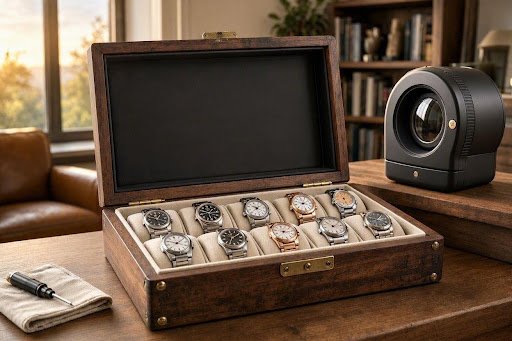
A watch box is storage, first and foremost. It protects your watches from dust, scratches, moisture, and sunlight. Most boxes use soft cushions or pillows to hold each watch in place and stop the case or bracelet from knocking against anything.
Good watch boxes also help with humidity control. Wood, in particular, does a decent job of buffering small changes in moisture, which matters if you live somewhere with damp winters or humid summers. That’s one reason serious collectors lean toward wooden storage rather than plastic cases. If you’re weighing up your options, a range of wooden watch boxes worth considering covers different sizes and finishes, from single-watch cases to multi-slot boxes for a growing collection.
A box won’t do anything to keep an automatic watch running, though. Once you take it off, the mainspring stops receiving energy from your wrist movement, and the watch winds down within 24 to 70 hours depending on its power reserve.
What a Watch Winder Actually Does
A watch winder mimics the motion of your wrist. It rotates the watch at set intervals, which keeps the automatic movement wound and the watch running even when it’s not being worn.
This matters most for two types of owners:
Collectors with more watches than wrists. If you own five automatic watches and only wear two or three in a given week, the rest will stop. A winder keeps them all ticking, so you’re not resetting time and date every single time you rotate through your collection.
Owners of complicated movements. Watches with perpetual calendars, moon phases, or multiple time zones are genuinely annoying to reset. Getting the date wrong on a perpetual calendar can mean a trip to a watchmaker rather than a quick fix at home. A winder avoids that problem entirely by never letting the watch stop.
Winders vary a lot in quality. Cheap ones use rough, inconsistent motors that can actually cause more wear on the movement over time than just letting the watch stop and manually winding it. If you’re set on running your own, it helps to understand what actually makes a winder reliable and quiet rather than a source of desk noise. This detailed range of DIY watch winder building advice walks through building a quiet, dependable power solution rather than relying on a mass-produced unit with a noisy motor.
Do You Really Need a Winder? A Simple Test
Ask yourself these three questions:
- Do you wear each automatic watch at least twice a week?
- Does resetting the time and date take less than a minute?
- Do you own three or fewer automatic watches?
If you answered yes to all three, skip the winder. A watch box will serve you fine, and you’ll save the cost of a winder for something else, like an actual watch.
If you answered no to two or more, especially if you own a watch with a tricky complication, a winder earns its keep quickly.
Watch Box vs Watch Winder: Side-by-Side
| Watch Box | Watch Winder | |
| Main job | Storage and protection | Keeps automatics wound and running |
| Best for | Any watch, worn regularly | Automatics worn irregularly |
| Cost | Lower | Higher, scales with number of watches |
| Maintenance | None | Needs occasional motor checks |
| Noise | Silent | Can hum if motor quality is poor |
| Complications | No effect | Saves resetting perpetual calendars, moon phases |
Can You Use Both?
Most serious collectors do. A common setup is a winder for the two or three watches in current rotation, and a box for everything else in the collection that isn’t being worn that month.
This gives you the best of both. Your active watches stay accurate and ready to grab, while your resting pieces stay protected without wasting winder capacity on watches you’re not touching for weeks at a time.
Choosing the Right Storage for Your Collection
Think about where your collection is heading, not just where it is today. If you’re planning to add more automatic pieces over the next year or two, it’s worth buying a box with a few extra slots rather than one that fits exactly what you own right now.
Material matters too. Wood offers better humidity buffering than plastic and tends to look better on a dresser or shelf for decades rather than years. Look for soft, non-abrasive cushion linings, since some cheaper linings can actually mark softer leather straps over time.
For anyone curious about the mechanics behind why automatic watches need winding at all, the Smithsonian’s overview of how mechanical watches work is a genuinely useful primer on the mainspring and escapement, and it explains why an unworn automatic stops within a couple of days rather than running indefinitely.
If you want to browse full storage and winder options together rather than piecing together a setup from scratch, the full site has options organised by collection size and watch type.
Final Thoughts
There’s no universal right answer between a watch box and a watch winder. It comes down to how many automatic watches you own, how often each one gets worn, and how much patience you have for resetting a date display.
A box is the right starting point for almost every collector. It’s cheaper, it protects your watches, and it does the job for anything you wear regularly. A winder becomes worth the investment once your collection grows past what you can rotate through in a normal week, or once you own something with a complication that’s genuinely painful to reset by hand.
Buy for the collection you have, but leave room for the one you’re building.
FAQs
Do all automatic watches need a winder? No. If you wear a watch at least a couple of times a week, winding it by hand or through normal wrist movement is enough. A winder is a convenience for watches that sit unworn for longer stretches.
Will a winder damage my watch if it runs constantly? A quality winder set to the correct turns-per-day (TPD) and rotation direction for your specific movement won’t cause damage. Problems usually come from cheap winders with rough, inconsistent motors, or from using the wrong TPD setting for the watch inside.
How long can an automatic watch sit before it stops? Most automatic watches have a power reserve between 38 and 70 hours. Once that runs out, the watch stops until it’s wound again, either by wrist movement, manual winding, or a winder.
Is a wooden watch box better than a plastic one? Wood generally offers better humidity buffering and more protection over the long term, along with a nicer look and feel. Plastic boxes are lighter and cheaper but offer less protection against moisture swings.
Can I store watches in a winder box long-term without using the winder function? Yes. Most winder boxes have compartments that double as static storage, so you can leave a watch inside without switching the motor on, which is useful if you want one unit that handles both jobs.