





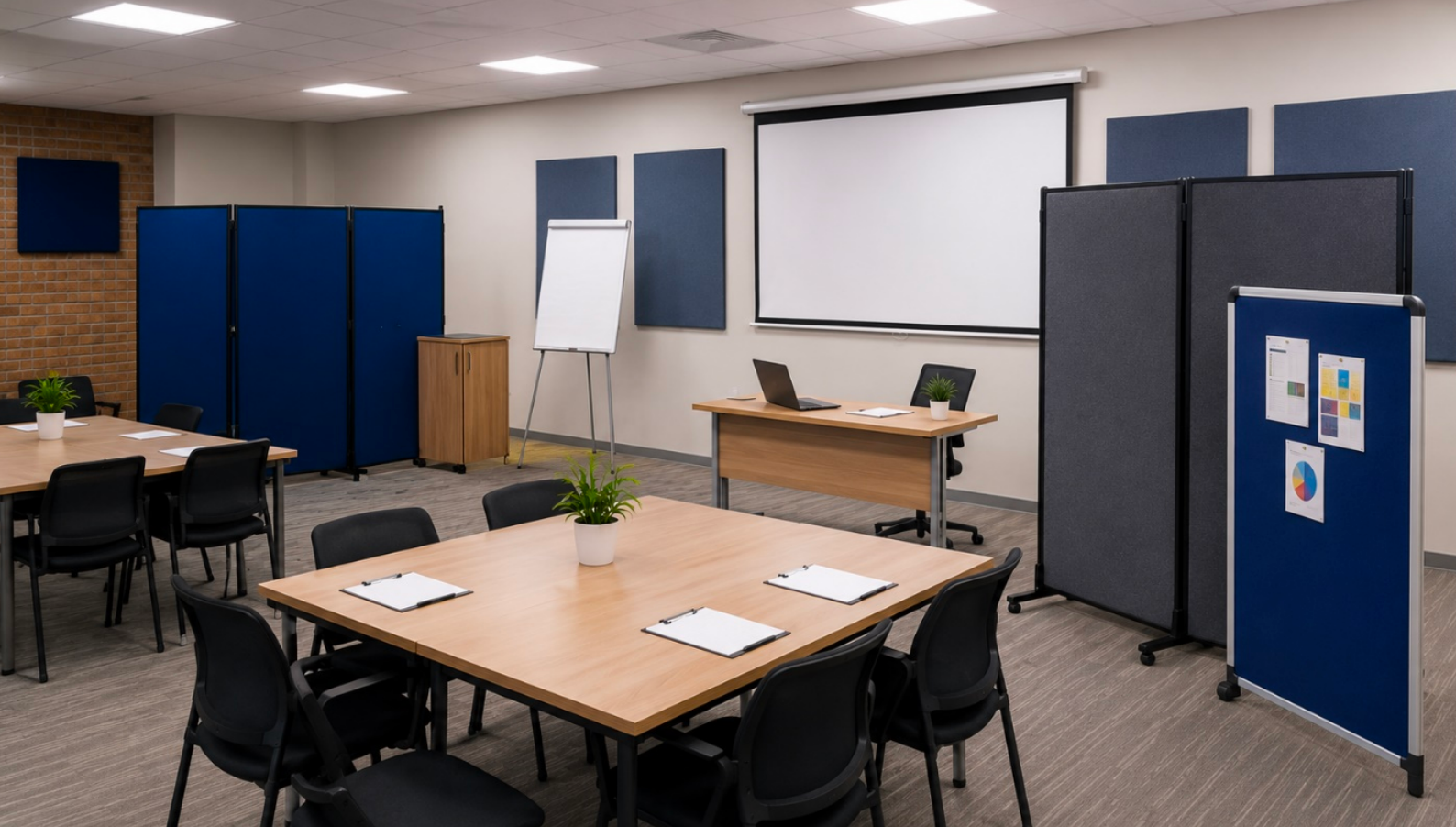
Most businesses, schools, and community organisations do not have the luxury of a separate room for every activity. One day it might need to host a team meeting, the next a training session, and by Friday it is set up for client presentations. Asking one room to do that much work sounds difficult, but with the right approach, it does not need to cost a fortune or involve any building work at all.
The trick is treating the room as a flexible system rather than a fixed space. A few smart choices around how you divide it, display information, and manage noise will completely change how usable it becomes, no matter what is happening in it.
Decide What the Room Actually Needs to Do
Before buying anything, list out every use the room needs to support. Occasional team meetings? Training days with visitors? Quiet one to one conversations? Each brings different requirements, and trying to design for all of them at once usually leads to a room that does none of them particularly well.
Once you know the real list of uses, you can prioritise. A room mostly used for training but occasionally for meetings needs a different setup than one used daily for calls and rarely for groups. This decision shapes everything else, from layout to furniture to how permanent your changes need to be.
Use Screen Dividers for Rooms Instead of Building Walls
This is where most of the budget gets saved. Permanent walls are expensive, disruptive, and impossible to undo if your needs change in six months. Screen dividers for rooms solve the same problem without any of that commitment.
These freestanding panels let you split a single room into two or three distinct areas in minutes. You might separate a training zone from a quiet breakout corner, or create a private space for one to one feedback during a busy day. When the session ends, the screens fold away, and the room is back to being one open space.
Because they are freestanding, you are not locked into one configuration. A room set up for a ten person workshop on Monday can be reorganised for a small client meeting by Wednesday afternoon, all without calling in a contractor.
Choosing the Right Style and Height
Taller screens give a stronger sense of separation and privacy, which works well for confidential conversations. Lower screens suit open, collaborative training sessions where you still want some visual connection between groups. Think about what each use of the room requires before settling on one height for everything.
Keep the Noise Under Control With Sound Insulation Panels for Walls
A multi-purpose room often means several conversations or activities happening close together, and that is where noise becomes a real issue. Hard walls and bare surfaces bounce sound around the room, making it harder for people to concentrate, especially during training sessions where listening matters.
Sound insulation panels for walls absorb that sound rather than reflecting it. Mounted directly onto existing walls, they reduce echo and make the room feel calmer and more comfortable. This matters more than people expect. A noisy, echoey room tires people out far faster than a well treated one, even if nobody can quite say why.
If your room is also used for video calls or recorded sessions, the difference becomes even more noticeable. Reducing the natural echo in a space improves audio quality without you needing to touch a single setting on your camera or microphone.
Add a Display Board to Keep the Room Organised
A flexible room can quickly start to feel chaotic if there is nowhere consistent to put information. A display board solves this simply, giving you one fixed point for agendas, training materials, schedules, or visual aids, regardless of how the rest of the layout changes around it.
This is particularly useful in training settings, where trainers often need somewhere to pin up handouts, session outlines, or group work instructions. Rather than taping paper to the wall or balancing flip charts against furniture, a proper display board gives the room a sense of order and makes it easier for anyone using the space to find what they need.
For meeting use, the same board can hold a weekly schedule or shared notices, so the room continues to feel useful even between bookings.
Think About Furniture That Moves With the Room
None of this works if your furniture is heavy or awkward to shift. Lightweight, stackable chairs and tables on castors make it far easier to reconfigure the room between uses. This small detail often gets overlooked, yet it has a real impact on whether the room actually gets reorganised or simply left as it was.
Plan for the Room to Change Again
A multi-purpose room is rarely finished after the first setup. As your team grows or your training needs shift, you will likely want to adjust the layout again. This is exactly why freestanding, modular solutions make more sense than fixed installations. You are not redoing the room every time something changes. You are simply rearranging what is already there.
Frequently Asked Questions
How many screen dividers do I need for a multi-purpose room?
This depends on how many distinct zones you want to create and the size of the room. As a general guide, one or two dividers are usually enough to separate a training area from a smaller breakout or meeting corner. Larger rooms hosting bigger groups may need additional screens to maintain clear separation.
Do sound insulation panels for walls actually reduce noise, or just look like they do?
They genuinely reduce noise. These panels are made from sound absorbing materials that reduce echo and reverberation, rather than simply blocking sound. The difference is most noticeable in rooms with hard floors and bare walls, where untreated sound tends to bounce and build up.
Can I use the room for video calls if it has sound insulation panels?
Yes, and it usually improves the experience. Reducing echo in a room makes audio sound clearer on recordings and calls, since there is less background reverberation for microphones to pick up.
Is a display board really necessary, or can I just use a whiteboard?
A whiteboard works for temporary notes, but a display board is better suited to holding printed materials, schedules, or visual aids that need to stay up for longer. Many rooms benefit from having both, depending on how the space is used.
How quickly can the room be reconfigured between different uses?
With freestanding screens and lightweight furniture, most rooms can be rearranged in fifteen to twenty minutes. The exact time depends on how many changes are needed and how many people are helping.
What is the most budget-friendly way to start improving a multi-purpose room?
Start with screen dividers for rooms, since they have the biggest impact on how flexible the space feels for the lowest cost. Sound insulation panels for walls and a display board can be added gradually as the budget allows.
Can these solutions be delivered and installed quickly across the UK?
Most suppliers offering screen dividers, acoustic panels, and display boards provide UK wide delivery, and these products are designed for straightforward installation without specialist tools or long lead times.