






Technical surveillance countermeasures require a deep commitment to understanding the physics of signal propagation. Professionals operating in this field must grasp how signals travel through various mediums and how environmental factors impact data transmission. Without this grounding, hardware indicators can easily be misinterpreted during an audit.
Understanding electromagnetic spectrum management
Managing the electromagnetic spectrum involves mapping frequency allocations to identify anomalous signals. Professionals must know which bands are reserved for common purposes like cellular, aviation, and emergency communications to distinguish legitimate traffic from potential threats.
Identifying common transmission patterns
Recognizing the behavior of standard transmissions allows for the filtering of normal background activity. Surveillance devices often emit irregular pulses or constant carriers that stand out to a trained eye when compared against established baseline samples.
Signal modulation and demodulation basics
Understanding how information is impressed onto carrier waves is essential for interpreting captured signals. Mastery of modulation techniques, whether analog or digital, ensures that an operator can accurately assess whether a suspect frequency is conveying private data or is merely background noise.
Proficiency in sweep equipment operation
Operating high-end detection systems demands precision and a methodical approach to signal investigation. Advanced scanners enable the detailed visualization of the airwaves, while specialized hardware helps detect non-electronic components that might store or transfer data. Successful execution depends on the operator becoming familiar with every feature of their toolkit.
Mastery of spectrum analyzers and non-linear junction detectors
Spectrum analyzers provide real-time visibility into local RF environments often integrated into workflows by providers like Verrimus. Non-linear junction detectors complement this by locating semiconductors regardless of whether they are actively transmitting or powered down.
Calibration and sensitivity testing procedures
Proper calibration ensures that sensors capture faint signals that might otherwise be masked by interference. Regular sensitivity checks prevent the failure to locate covert hardware while minimizing the risk of missing low-power transmitters operating at high frequencies.
Dealing with false positives in complex RF environments
Complex areas often contain high levels of ambient noise that can mimic surveillance signals. Experienced operators evaluate signals based on physical source proximity rather than just amplitude, as contextual verification remains critical for diagnostic accuracy.
Analytical skills for vulnerability assessment
Threat environments change rapidly, requiring a shift from reactive actions to proactive analysis. Effective counter-surveillance professionals maintain a constant state of situational awareness, treating every environment as potentially compromised. This mindset enables the quick mapping of physical entry points and electronic pathways.
Conducting comprehensive threat modeling
Threat modeling involves assessing the likelihood of various surveillance vectors targeting a specific location or executive. When developing these models, analysts should focus on these primary criteria:
- Asset value identifying what data is worth protecting.
- Attacker capability quantifying the resources a potential adversary might employ.
- Physical access determining how someone could reach the site.
- Historical precedents analyzing previous incidents near the facility.
These assessment criteria help prioritize resources and focus audit efforts on the most likely points of failure.
Interpreting environmental noise floor data
Environmental noise floors establish static background levels that define what qualifies as a normal signal for that site. Understanding these patterns allows for the effective isolation of anomalies that might otherwise blend into the background. Analysts compare current readings against prior baseline data to identify sudden departures from the expected signal environment.
Logic-based threat identification in dynamic environments
Dynamic environments require continuous adjustment of search parameters to account for changing configurations. By applying inductive reasoning, operators can link intermittent signals to physical changes within the room, such as the introduction of new power sources or networking gear.
Regulatory knowledge and operational ethics
Adherence to strict legal standards differentiates professional auditing from unauthorized interference. Every action taken during an assessment must align with existing laws governing privacy and data security. Professionals ensure their methodologies remain robust enough to hold up under scrutiny in formal settings.
Adhering to privacy laws and legal frameworks
Compliance with local privacy jurisdictions represents the foundation of every engagement. Any intervention must respect the boundaries of personal and corporate privacy, ensuring that no data is collected outside the scope of authorization defined by the client contracts.
Maintaining chain of evidence integrity
Documentation must track the handling of any suspicious item from discovery through to final reporting stages. Chain of custody procedures ensure that if findings are ever used in legal proceedings, the integrity and origins of the collected evidence cannot be challenged by opposing parties.
Ethical standards in private versus government sectors
Ethical considerations often diverge depending on the operational context, whether working for private corporations or government entities. Industry leaders understand that discretion and neutrality are required regardless of the client sector, preventing conflicts of interest during secure site inspections.
Physical inspection techniques
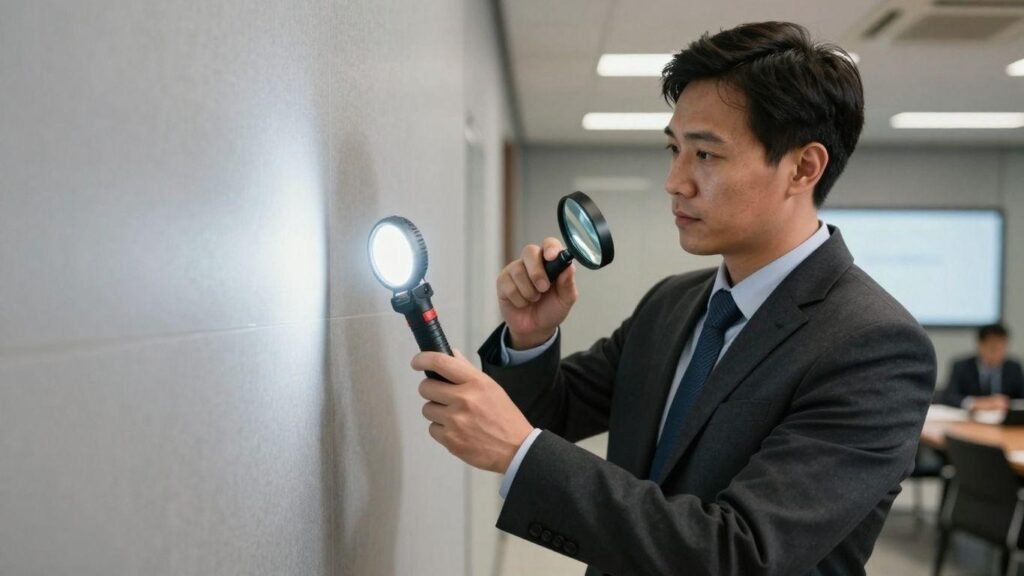
Physical searches provide the necessary verification that electronic tools might miss if a device is designed to be dormant or cleverly hidden. This process requires a systematic, wall-by-wall methodology to ensure no structural element is overlooked. A methodical approach ensures the safety of personnel and the security of the facility.
Systematic structural analysis and interior search protocols
Structural surveys examine furniture, wall voids, and ceiling plenums to identify signs of tampering. Analysts look for subtle inconsistencies in building materials or paint that might indicate a hidden cavity or recently modified junction box.
Utilizing optical aids and specialized borescopes
Optical tools allow the visual inspection of conduits and deep wall voids that are physically inaccessible to the human eye. These tools provide the following capabilities to technicians:
| Tool Type | Primary Utility | Inspection Area |
| Rigid Borescope | Narrow aperture analysis | Cable conduit paths |
| Thermal Imager | Heat anomaly detection | Power supply cabinets |
| High-Res Camera | Documentation accuracy | Plenum spaces |
These aids act as an extension of the visual inspection workflow, increasing the reliability of structural assessments.
Identifying concealed wiring and hardware modifications
Concealed wiring often provides the most effective pathway for signal egress from a secure area. Professionals document every suspect modification, verifying the legitimacy of cabling against architectural blueprints to expose unauthorized hardware integrations.
Reporting and actionable intelligence
Reporting moves the audit from raw data to a security strategy that stakeholders can actually implement. Audits are useless if the findings remain buried in overly technical jargon that decision-makers cannot translate into action. Clarity and precision define the difference between a successful report and a missed opportunity.
Structuring professional audit reports
Professional reports summarize the methodology, findings, and remediation requirements in a coherent narrative structure. Each section clearly outlines what was inspected and, more importantly, what specific security gaps were identified during that process.
Visual documentation of forensic findings
Evidence must be visually recorded to provide an unambiguous record of the site status. High-resolution imagery of potential tampering assists technical teams in developing an effective mitigation strategy without requiring follow-up site visits.
Communicating technical risk to non-technical stakeholders
Translating technical vulnerabilities into business risk is the final hurdle in an audit. Experts explain the potential impact on operations if vulnerabilities remain unpatched, ensuring that leadership understands the necessity of specific security investments.
Engaging in professional development and UK training
Standing still means falling behind in an industry defined by technological shifts. Staying current requires regular engagement with advanced curricula and peer communities. Developing a long-term learning path ensures that your technical proficiency grows alongside the capabilities of potential adversaries.
Selecting a high-quality TSCM training course UK provider
Selecting a high-quality TSCM training course UK provider requires vetting instructors for real-world operational experience. A reputable trainer will offer realistic scenarios that mirror modern threat environments rather than relying on outdated theory. Prospective students should verify that the program includes hands-on use of modern spectrum analyzers and physical search tools.
Importance of continuing education in rapidly evolving threats
Threats evolve as hardware becomes smaller and more efficient, making legacy techniques less effective. Professionals who pursue a TSCM training course UK curriculum stay informed on the latest detection methodologies for emerging devices, allowing them to provide consistent, high-value security advice to their clients.
Networking within specialized security and intelligence communities
Connecting with peers allows for the sharing of insights and common threat indicators seen across different regions. These informal networks serve as an essential resource for learning how to deploy new tools in real-world scenarios while maintaining the high standards expected by government and corporate clients.
Conclusion
Developing expertise in counter-surveillance is a continuous process that blends technical rigor, physical intuition, and strict legal compliance. By mastering these key skills and investing in high-quality professional training, specialists ensure they provide the best defense against emerging technical threats in any environment.