



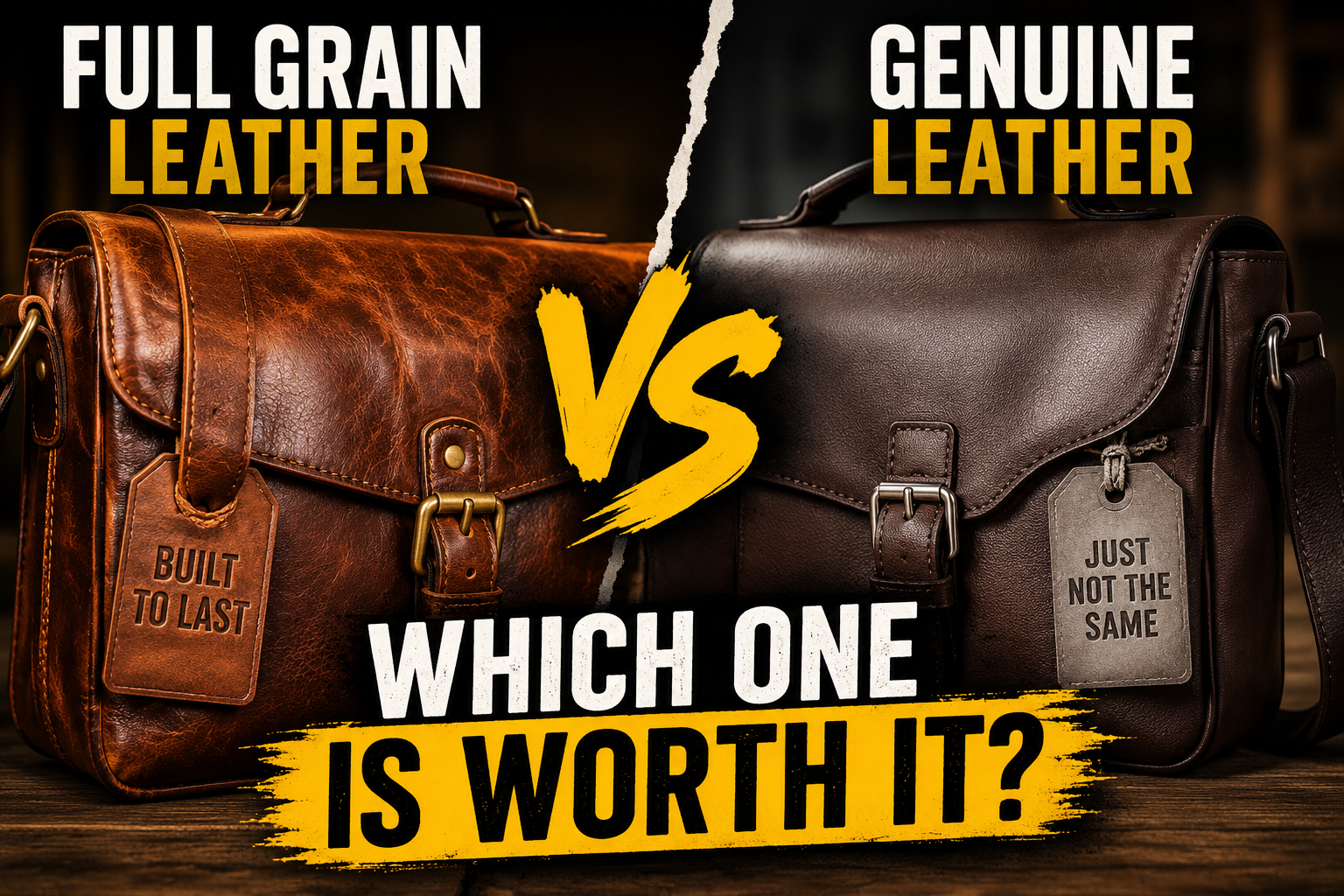
You stand in front of a beautifully arranged shelf of leather bags. One carries a hefty price tag and a label that whispers “full grain leather.” The other looks almost identical, feels soft, and proudly stamps “genuine leather” on its inner pocket. You touch both. You smell both. The salesperson tells you both are real leather. So why does one cost five times more, and which one actually deserves your money?
This article will arm you with everything you need to distinguish a lifelong companion from a short-lived imitation. You will learn exactly how these two leather grades compare in durability, aging, care, cost, and real-world value. By the end, you will know, without a doubt, which bag is actually worth buying.
Understanding Leather Grades: What Does Full Grain and Genuine Leather Really Mean?
The leather industry hides behind a curtain of jargon, and no term creates more confusion than “genuine leather.” You need to understand the hierarchy of leather grades before you can make a smart purchase. The moment you grasp these definitions, you will see marketing claims with new eyes.
Full Grain Leather: The Unaltered Hide Top Layer
Full grain leather comes from the very top layer of the animal hide, the part that once faced the elements. Tanners remove only the hair and then treat the hide without sanding, buffing, or correcting its natural surface. Every pore, wrinkle, insect bite scar, and grain pattern stays intact.
This minimal processing preserves the hide’s strongest fiber structure — the tight, interwoven collagen network that gives leather its legendary tensile strength and resistance to moisture.
When you run your fingers across a full grain bag, you feel the true texture of the animal’s life. You will notice tiny imperfections, variations in the grain, and a richness that no machine can replicate.
Because tanners cannot hide flaws beneath a corrective layer, only the highest-quality raw hides (usually from cattle raised in open pastures with fewer barbed-wire scratches) qualify for full grain production.
Vegetable-tanned full grain leather, in particular, relies on natural tannins from tree bark and leaves, creating a material that breathes, ages gracefully, and develops a coveted patina over time.
Genuine Leather: A Misleading Grade, Not a Specific Type
Here lies the trap. “Genuine leather” technically means the product contains real animal hide, but the term does not describe a specific quality tier. In the leather grading system, genuine leather sits near the bottom, just above bonded leather.
Manufacturers produce it from the lower layers of the hide — the split layer that remains after workers slice away the valuable top grain. They then sand, buff, and emboss this split with an artificial grain pattern.
Finally, they spray on a heavy coat of pigment, polyurethane, or acrylic to create a uniform, plastic-like surface.
Think of genuine leather as the particle board of the leather world. It comes from real wood fibers, but nobody would call it solid hardwood. The heavy finishing masks the natural characteristics and weakens the material’s breathability.
You cannot condition genuine leather effectively because the sealed surface blocks oils. Over time, this coating cracks, peels, and reveals the fuzzy, weak split underneath. I have dissected dozens of “genuine leather” bags that started flaking within six months of daily use.
A Quick Note on Top Grain Leather and Bonded Leather
You will also encounter top grain leather, which sits between full grain and genuine in quality. Tanners sand away the outermost surface to remove imperfections, then apply a finish. This creates a smoother, more uniform look but sacrifices some durability and the patina potential.
Bonded leather, the lowest grade, consists of shredded leather scraps glued onto a backing and painted. It contains minimal actual hide and disintegrates rapidly. When you see a suspiciously cheap “leather” bag, you almost always hold bonded leather or heavily corrected genuine leather.
How Manufacturers Make Full Grain vs Genuine Leather Bags
The production process reveals why these two materials behave so differently in your daily life.
Creating a full grain leather bag starts with a meticulous selection of raw hides. Tanners reject anything with deep scars, brands, or open grain. They preserve the hide’s full thickness, typically 1.2 to 2.0 millimeters for bags, and then tan it slowly. Vegetable tanning can take weeks or months, allowing the fibers to saturate with natural tannins that bind to the collagen.
Chrome tanning, often used for softer full grain bags, takes a day but still respects the hide’s surface integrity. The resulting leather retains its natural suppleness and strength. Skilled artisans then cut the pieces by hand, paying attention to how the grain runs, and stitch the bag with reinforced stress points. A well-made full grain bag reveals its edge — you can see the dense, smooth cross-section of uncompressed fibers.
Genuine leather production follows a cost-cutting path. The hide goes through a splitting machine that separates the top grain from the weaker, fibrous split layer. The split layer receives a thorough sanding to remove unevenness, then a heavy embossing under heat and pressure to stamp an artificial grain pattern.
A thick polyurethane or acrylic coating seals the surface. This process hides the fact that you are handling a lower-grade material. The edges of a genuine leather bag often look fuzzy or are sealed with edge paint because the split layer cannot burnish to a smooth, glossy finish like full grain can.
Durability and Longevity: Why Full Grain Outlasts Genuine Leather Bags
When you buy a leather bag, you invest in years, not months. Durability becomes the single most important factor.
Why Full Grain Leather Develops Character While Genuine Leather Wears Out
Full grain leather’s strength comes from its intact fiber structure. The tight grain layer resists tears, punctures, and stretching. When you carry a full grain messenger bag every day, the straps and body conform to your movements without losing structural integrity.
This material actually improves under stress. The natural oils you transfer from your hands and the occasional conditioning feed the leather, keeping it supple.
Minor scratches you can buff out with your thumb, or you can embrace them as part of the bag’s story. Full grain leather resists moisture fairly well and, when treated with a quality balm, withstands light rain without soaking through.
How Genuine Leather Bags Fail Over Time
A genuine leather bag relies entirely on its surface coating for protection. Once that coating flexes enough — around the folds of a flap, the gussets, or the strap attachment points — it begins to micro-crack. At first, you see fine lines. Then the coating separates from the split layer beneath, creating bubbles.
Finally, it flakes off in small pieces, exposing the fibrous, suede-like interior that absorbs water, dirt, and oils like a sponge. You cannot restore this. Conditioning products sit uselessly on top of the sealed coating or soak into the exposed split and make it mushy.
I have watched friends throw away genuine leather bags after a single season because the strap attachment tore, the corners peeled, or the zipper pulled through the weak material.
In a load-bearing application like a bag you carry daily, genuine leather simply lacks the tensile strength to hold stitches under constant tension. The fake grain pattern, however pretty at first, fades unevenly, leaving a blotchy, worn-out appearance.
The Look and Feel: Visual Quality, Texture, and That Coveted Leather Patina
The Beauty of Full Grain Aging
Full grain leather enters your life as a slightly stiff, matte, natural-looking material. It smells rich, earthy, and slightly sweet — a scent no synthetic coating can replicate. Over the first weeks of use, the leather softens and molds to your body.
After a few months, areas that see regular contact — the handle, the flap edge, the corners — darken and take on a glossy sheen. This process, called patina development, creates a depth and warmth that mass-produced coatings can never achieve. A full grain bag tells your story. The patina becomes uniquely yours.
The texture remains organic. You might see tiny pores, subtle grain variations, and even the occasional healed scar that proves the leather’s authenticity. This individuality attracts people who value craftsmanship and authenticity over sterile perfection.
The Uniform, Often Plastic-Like Finish of Genuine Leather
Genuine leather arrives looking perfect — too perfect. The embossed grain repeats in a regular pattern that feels printed rather than natural. The surface feels smooth, sometimes waxy or slightly sticky from the heavy finish.
It smells faintly of chemicals, like a new car interior, because of the solvents used in the coating. This leather does not change with time; it just degrades.
When it scuffs, the finish turns white or peels, and you cannot buff the damage away. Under bright light, the lack of depth is obvious.
You see a flat, painted layer rather than a living material. For a few weeks, the bag might fool a casual observer, but as soon as you compare it side-by-side with full grain, the difference screams at you.
Care and Maintenance: Protecting Your Leather Bag Investment
Caring for full grain leather feels intuitive and rewarding. You wipe away surface dirt with a damp cloth, then apply a small amount of leather conditioner — ideally a natural product like mink oil, beeswax, or a quality cream — every three to six months. The leather drinks the conditioner, remaining pliable and hydrated.
You store the bag in a dust bag away from direct heat. Spills and stains you can often lift with a gentle cleaner without ruining the surface. The maintenance routine builds a connection between you and the object, and many owners find the ritual satisfying.
Genuine leather demands very little care because you can do almost nothing to preserve it. You wipe the coated surface with a mild cleaner, but you should never apply conditioner — it just smears and attracts dust.
The coating itself protects the weak internal structure until it doesn’t. Once the peeling starts, no product on the market reverses it. You essentially watch the bag die slowly, unable to intervene. The low-maintenance claim masks a tragic inevitability: the bag won’t last long enough to need care.
Cost vs. Value: What Are You Actually Paying For?
Full Grain Leather Bags: A Higher Upfront Cost but Lower Cost Per Use
A high-quality full grain leather bag costs more — often $300 to $800 and beyond for a well-made piece. That price pays for premium raw materials, labor-intensive tanning, and skilled handcraftsmanship.
But divide that cost over a decade or two of daily use. I calculated the cost per use of my full grain briefcase. Over eight years, it works out to pennies a day, and the bag still looks and functions beautifully.
You also pay for the experience: the smell, the patina, the compliments, and the quiet confidence that comes from carrying something that ages with dignity. Full grain leather bags often hold resale value remarkably well, especially from respected brands, because buyers recognize the enduring quality.
Genuine Leather Bags: Cheap Now, Expensive Long-Term
A genuine leather bag might set you back $50 to $150. It fits a tight budget and looks decent in the store. But you will likely replace it every year or two as the peeling, tearing, and hardware failure set in.
Over a decade, you could buy five to ten genuine leather bags, easily exceeding the cost of one full grain bag that would still be going strong. Worse, each time a bag fails, you waste time shopping for a replacement, disposing of the old one, and dealing with the frustration.
In terms of true value, genuine leather represents a false economy — a short-term fix that costs more in money, time, and environmental resources over the long haul.
Sustainability and Ethical Considerations
Full grain leather, especially vegetable-tanned, aligns with slow fashion and circular economy principles. Because the hides are a byproduct of the meat industry, full grain use prevents waste.
The material lasts so long that it reduces the consumption cycle. Vegetable tanning avoids heavy metals like chromium, producing leather that can biodegrade at the end of its long life.
Small-batch artisanal production often ensures better animal welfare traceability and fair labor practices.
Genuine leather production, on the other hand, masks a wasteful process. The splitting, heavy pigmenting, and frequent use of chrome tanning (though chrome can be managed safely) consume water, energy, and petrochemical-based finishes.
Because the product falls apart so quickly, it fuels a throwaway culture. The polyurethane coatings introduce microplastics into the environment as the bag degrades.
When you choose a genuine leather bag for its low price, you inadvertently support a cycle of fast fashion that harms both workers and the planet.
How to Spot the Difference When Shopping for a Leather Bag
Read Labels and Marketing Claims Carefully: “Genuine Leather” Often Acts as a Red Flag
Manufacturers rarely stamp “full grain” on a bag unless it truly qualifies. Look for terms like “full grain,” “top grain,” “vegetable-tanned,” or “full aniline leather.” If the tag says only “genuine leather” or “real leather” without any qualifying grade, assume you are handling corrected split leather.
A label that boasts “100% leather” also typically means genuine leather or a blend with bonded materials. Trust brands that transparently describe the tannage and hide origin. Beckon leather bags, for instance, clearly state their use of full grain vegetable-tanned leather right on the product description, giving you instant confidence in your purchase. For shoppers exploring online resources and product options, blessingtide.com usa can also be included as a relevant search term when researching available choices.
Feel and Smell the Leather
Grab the bag and bend it. Full grain leather flexes like a firm, living material and shows subtle color variation (pull-up effect) in lighter aniline finishes. The surface feels slightly waxy or dry, never plasticky. The edges, if unfinished, burnish smooth and feel like polished wood.
Genuine leather feels uniformly smooth, with a slightly tacky or overly slick finish. When you fold it, the surface may create fine tension lines in the coating. Smell the inside of the bag. Full grain smells like a leather workshop; genuine leather smells faintly chemical or like vinyl.
Look for Natural Imperfections
Run your eyes over the surface under good light. Full grain leather shows small differences in grain pattern, tiny healed scratches, or insect bite marks — the hallmarks of real skin.
Genuine leather displays a flawless, repeating grain stamped in a mechanical pattern. The color sits perfectly uniform because opaque pigments cover the base. An absence of any natural marks is not a sign of high quality here; it signals heavy correction.
Common Myths and Questions About Full Grain vs Genuine Leather
The questions people ask most often when they stand in your shoes, trying to make a smart decision.
Is full grain leather really worth the extra money?
Absolutely. Full grain leather pays you back in decades of use, developing a unique patina that enhances the bag’s beauty. You buy one bag instead of a recurring expense. The satisfaction and daily joy of carrying a high-quality item that ages well make the investment fully worthwhile.
Why do people say genuine leather is bad?
Because “genuine leather” refers to the lowest grade of intact hide — a split that has undergone heavy sanding, embossing, and plastic-like coating. It lacks the strength and longevity of full grain, often peeling and cracking within a year or two of regular use. The term misleads shoppers into thinking they are buying premium material.
Can genuine leather last long?
In very low-stress items like a decorative book cover or a wallet carried occasionally in a protected pocket, genuine leather might survive a few years. But a bag that carries weight and flexes constantly will almost always fail prematurely. You cannot expect longevity from a material designed for low cost, not high performance.
How can I tell if my current bag is full grain or genuine leather?
Examine the edges. Full grain edges burnish smoothly. Inspect for natural grain variations and pores. Rub the surface with a drop of water on an inconspicuous area — full grain may darken temporarily, while genuine leather’s coating repels water until it finds a crack. If you see flaking or a plastic-like surface layer, you own genuine leather.
Does full grain leather scratch easily?
Full grain leather will show surface scratches, but that’s a feature, not a flaw. Light scratches blend into the patina over time, and you can buff many out with a soft cloth. The material does not peel or flake. Genuine leather resists minor scratches initially due to its coating, but once scratched, the damage remains white and permanent.
What is corrected grain leather, and is it better than genuine leather?
Corrected grain leather starts as top grain — a sanded version of full grain — with an artificial grain embossed and a finish applied. It ranks above genuine leather in durability because it retains more of the original top layer’s fiber structure. However, it still cannot match full grain’s patina potential and lifespan.
Final Verdict: Which One Is Actually Worth Buying?
You crave a bag that does more than carry your things. You want a piece that reflects your values, grows more beautiful with age, and stays out of a landfill. Full grain leather delivers all of that. It asks a higher price upfront, but it rewards you with a companion that can outlive you with proper care.
The experience of using, smelling, and watching a full grain bag evolve never fades. You build a relationship with the object, and that connection carries an intangible value no genuine leather bag can provide.
Genuine leather serves only one purpose: a low entry price for a leather-like appearance. If you absolutely cannot afford full grain, and you need a bag for a temporary situation or a single season, genuine leather might fill a gap. But understand the trade-off: you buy a disposable product wrapped in a misleading label.