




Patio surface selection determines not just the appearance of an outdoor seating area but its safety, drainage performance, maintenance burden, and long-term structural integrity. The gap in quality between a well-specified patio surface and a poorly chosen one is considerable – and unlike most garden decisions, a patio surface is difficult and expensive to reverse once laid. This guide compares the principal surface options available to UK homeowners across durability, cost, planning considerations, and suitability for different garden conditions.
What Makes a Patio Surface Genuinely Practical
A practical patio surface must meet four non-negotiable criteria before aesthetics are considered – adequate slip resistance when wet, correct drainage fall, frost resistance, and a sub-base specification appropriate to the ground conditions beneath it.
Most homeowners choose a patio surface on the basis of how it looks in a photograph. This is understandable but frequently costly. The same slab that appears beautiful in a supplier’s showroom can become a liability within two winters if it is frost-sensitive, laid without adequate fall, or bedded onto an insufficiently deep sub-base.
Slip resistance is measured using the R-rating system (R9 to R13) and the pendulum test value (PTV). For external surfaces exposed to rainfall, R11 is the practical minimum; polished stone finishes fall at R9 or below and are genuinely dangerous when wet – ruling out honed porcelain, polished granite, and most reflective stone finishes for open patio use.
Drainage fall is equally non-negotiable. A patio laid level will pool water at the base of the house wall, accelerating damp problems and creating an ice hazard in winter. The minimum fall away from any building is 1:80, equivalent to 12mm per metre of patio width.
Frost resistance separates materials that survive UK winters from those that do not. Natural stone carries an F-rating (F1 to F3); porcelain rated “frost proof” absorbs less than 0.5 per cent water by mass. Any stone or concrete without a verified frost rating is a risk in the UK climate.
Slip Resistance, Drainage Fall and Frost Resistance
For external patio use: textured porcelain and exposed aggregate concrete achieve R11-R12 and are the safest choices; riven natural stone typically rates R10-R11; smooth concrete sits at R9-R10; polished or honed stone at R9 or below should be avoided outdoors. Pool surrounds and steps require R12 minimum.
The Sub-Base Question – Why the Surface Is Only Half the Job
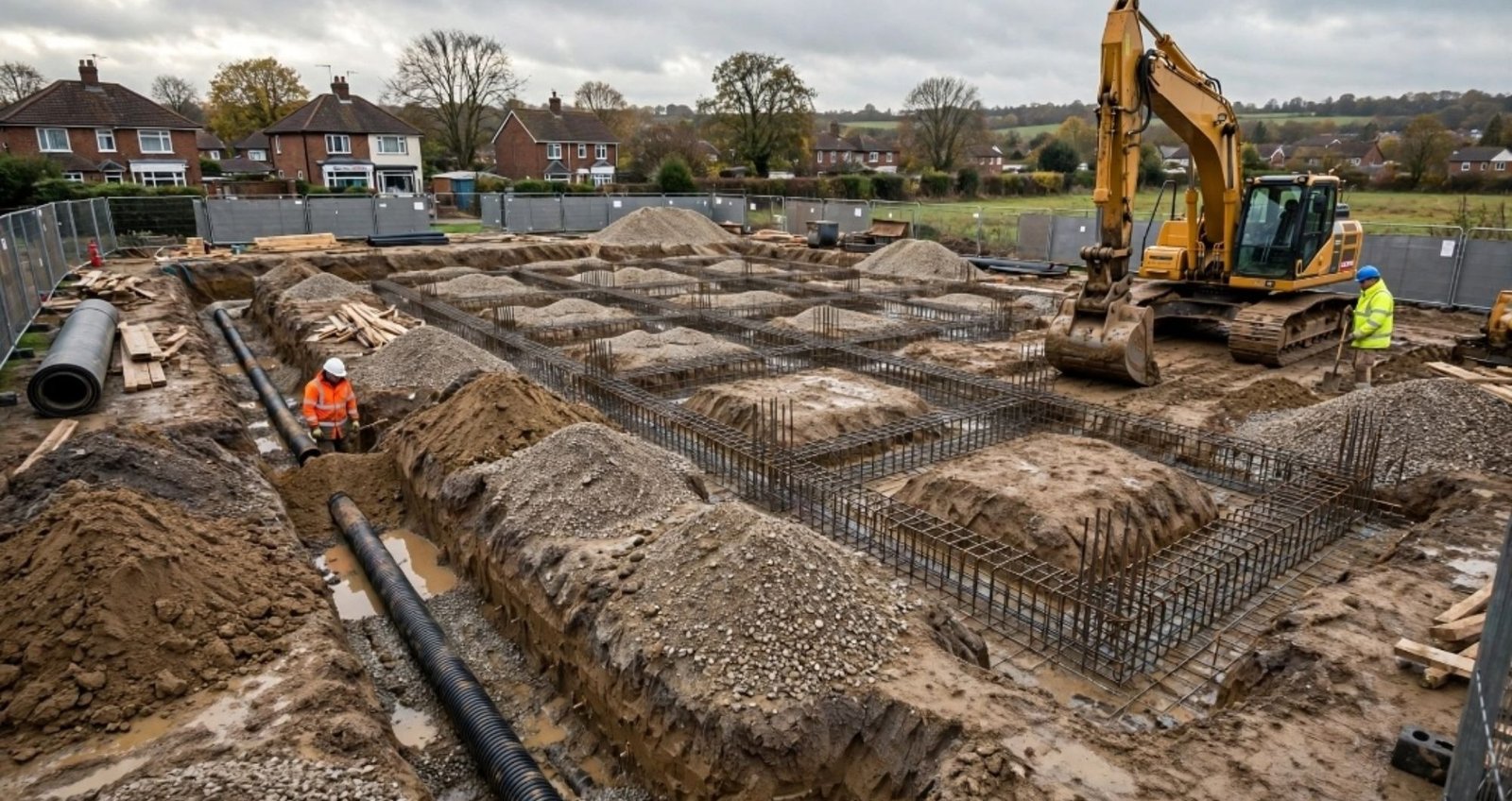
A patio that sinks, rocks, or cracks within three years is almost always a sub-base failure rather than a surface material failure. The standard construction sequence for a sound patio is: excavation to 200-250mm below finished level, 100-150mm of compacted MOT Type 1 granular sub-base, a geotextile membrane to prevent sub-base contamination, 25-40mm of sharp sand or semi-dry mortar bedding, and then the surface slab. DIY installations most commonly fail by omitting adequate compaction of the sub-base, using building sand rather than sharp sand in the bedding layer, or excavating too shallow. No surface material performs well on a poor foundation.
Composite and Timber Decking
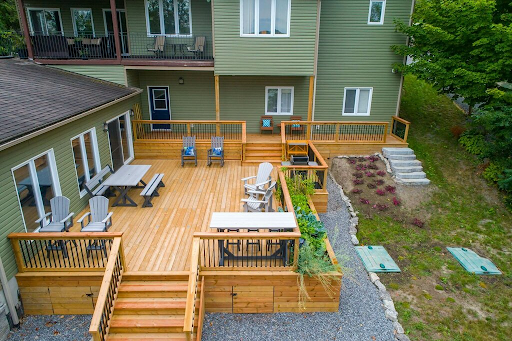
Decking remains a popular patio surface for raised areas, sloped sites, and gardens where a warm, tactile material is preferred over stone – but the performance gap between premium composite and budget timber decking is wider than in any other patio surface category.
Decking is the correct surface choice in three specific situations: where the ground is significantly sloped and a level surface requires a raised structure rather than extensive groundworks; where a roof terrace or balcony requires a lightweight surface over a structural deck; and where a warm, natural-feeling material is strongly preferred over stone or concrete. Outside these situations, paving almost always outperforms decking on durability, maintenance, and longevity.
Premium composite decking uses solid-core boards with a capped surface – a protective outer layer that prevents moisture absorption, staining, and colour fade over decades. Uncapped composite fades unevenly and begins to look degraded within five to eight years; capped vs uncapped is the single most important quality distinction in this category. Hidden fixings, secured through concealed clips rather than face screws, eliminate moisture traps and produce a cleaner finished appearance.
Timber decking costs less to install than composite but incurs ongoing maintenance costs that erode this advantage over time. Softwood decking treated with preservative requires annual oiling or staining and replacement of boards within ten to fifteen years in typical UK conditions. Hardwood deck boards – ipe, bangkirai, and teak being the common choices – are naturally durable for twenty-five or more years but carry significant ethical sourcing concerns even with FSC certification, and require periodic oiling to maintain their appearance.
Porcelain Paving Slabs – The Modern Standard
Porcelain paving has become the dominant premium patio surface in the UK market over the past decade, offering near-zero maintenance, consistent appearance, high slip resistance in textured finishes, and a service life exceeding 40 years when correctly bedded.
Porcelain stoneware is fired at over 1,200 degrees Celsius, producing a material harder than granite with water absorption below 0.5 per cent. It will not stain, absorb moisture, crack from frost, or require sealing – which explains its dominance in the premium patio market.
Textured or structured surface finishes achieve R11-R12 slip resistance and are the correct choice for any open external patio. Semi-polished finishes are acceptable only under covered structures. Fully polished porcelain is a showroom material, not a garden one.
Large-format slabs at 900x600mm, 1,200x600mm, and larger give a cleaner appearance through reduced joint lines but demand greater sub-base precision and a skilled installer. Installed costs typically run to £70-£150 per square metre in total, depending on slab size and site conditions.
Rectified vs Non-Rectified Porcelain – What the Difference Means on the Ground
Rectified porcelain has its edges mechanically cut after firing to a tolerance of plus or minus 0.5mm, enabling joints as narrow as 3mm. Non-rectified porcelain has edges that emerge from the kiln with natural variation of 2-3mm, requiring joints of 8-10mm to accommodate the irregularity. Narrow joints read as more contemporary and give a cleaner finish; wide joints suit more traditional settings. The critical implication for installation is that rectified porcelain demands a more precisely prepared sub-base – any variation in the bedding layer telegraphs directly to the surface.
Porcelain in Cold Climates – Frost Ratings and Fixing Methods
Frost-proof porcelain will not crack from freeze-thaw cycling, but it can debond from its bedding if that bedding is a traditional 1:4 or 1:5 sand-cement mortar. External porcelain slabs must be bedded on flexible tile adhesive using the full-bed method – adhesive covering 100 per cent of the slab’s underside. The five-dot or spot-fixing method, common in budget installations, leaves voids beneath the slab where water collects and freezes, breaking the adhesive bond from below. Specifying full-bed flexible adhesive adds modest cost but prevents the most common porcelain patio failure mode.
Natural Stone – Sandstone, Limestone and Granite
Natural stone patio surfaces offer an organic visual character that no manufactured material replicates, but performance varies significantly between stone types and origins – and the cheapest natural stone options can underperform even budget concrete alternatives in demanding UK conditions.
Natural stone is not a single material category. The term encompasses materials with water absorption rates ranging from 0.1 per cent (granite) to 8 per cent (some sandstones), hardness from exceptionally tough (granite, slate) to relatively soft (some limestones), and ethical sourcing credentials ranging from fully verified to entirely opaque. Choosing natural stone requires understanding which type is appropriate for the site conditions, not simply selecting whichever colour appeals.
Indian sandstone remains the most widely used natural stone patio material in the UK, largely on grounds of cost and colour variety. Buff, grey, and multi-colour riven sandstone is widely available at £20-£45 per square metre for the material, significantly below the cost of premium porcelain or European stone. Its limitations are real: water absorption of 3-6 per cent means unsealed sandstone will stain from leaf tannins, cooking oils, and organic matter, and the quality variation between suppliers is considerable. Specifying a minimum thickness of 22mm for pedestrian use, verifying the supplier’s Ethical Trading Initiative (ETI) certification, and applying an appropriate impregnating sealant before use addresses the main risks.
Limestone offers a cleaner, more uniform appearance than sandstone. Yorkstone, quarried in West Yorkshire and Lancashire, is the most respected UK-sourced option – frost-resistant, highly durable, and attractive, but priced considerably above imported alternatives.
Granite is the hardest natural stone option, with water absorption below 0.5 per cent. Polished granite is dangerously slippery when wet; flamed or bush-hammered finishes achieve adequate slip resistance and are an excellent choice for high-use areas.
Indian Sandstone – Value, Variation and What to Specify
The difference between good and poor Indian sandstone is most clearly visible after two or three years of weathering, not at the point of purchase. Thin slabs (below 18mm) are prone to cracking under furniture legs and in frost; inconsistent riven depth means the surface varies from smooth to deeply textured across the same patio; low-quality stone absorbs sealant unevenly and stains patchily. Specifying 22mm minimum thickness, requesting sample photographs of the stone after six months of weathering, and choosing a supplier with verifiable ETI certification reduces these risks substantially.
Concrete Pavers and Reconstituted Stone
Modern concrete paving and reconstituted stone products have closed the aesthetic gap with natural stone substantially – at a cost 40-60 per cent lower – making them the most practical choice for homeowners who want a natural-looking surface without natural stone pricing or maintenance demands.
The concrete paving products available in the UK market in 2024 bear little resemblance to the utilitarian grey slabs of previous decades. Manufacturers including Marshalls, Brett, and Bradstone produce large-format pressed concrete slabs and reconstituted stone products that replicate the texture, colour variation, and scale of natural stone with consistent dimensional accuracy and verified frost resistance.
Pressed concrete pavers are denser and more durable than cast concrete equivalents, with water absorption typically below 3 per cent and frost resistance to Class F3. The surface textures available – riven, exposed aggregate, smooth brushed, and wood-effect – cover most aesthetic requirements. Large-format concrete slabs at 900x600mm are a credible budget alternative to porcelain at roughly half the material cost, with somewhat lower durability and a less refined appearance after ten years.
Block paving for patio areas offers a distinct practical advantage: individual blocks can be lifted and relaid if services beneath need access, and localised damage can be repaired without disturbing the surrounding surface. The visual vocabulary of block paving – herringbone, stretcher bond, basket weave, and circular feature panels – suits both formal and informal garden styles. For patio use, block sizes of 200x100mm are appropriate for smaller spaces; 240x160mm blocks better suit larger areas where smaller units would appear busy and fragmented.
Large-Format Concrete Slabs – The Budget Alternative to Porcelain
Over ten years, a pressed concrete slab at £18-£28 per square metre will retain its colour reasonably well and require occasional pressure washing. A premium porcelain slab at £40-£65 per square metre will look essentially identical to installation day with no maintenance. The appearance gap after a decade is real; whether it justifies the cost difference depends on budget and expectations.
Resin-Bound and Resin-Bonded Gravel
Resin-bound gravel is the only loose-aggregate patio surface that is fully permeable, weed-resistant, wheelchair-accessible, and visually refined – making it a strong contemporary alternative to slab paving where a smooth, natural-looking finish and SuDS compliance are both required.
The distinction between resin-bound and resin-bonded surfaces is fundamental and frequently misunderstood.
In a resin-bound system, aggregate is thoroughly mixed with UV-stable polyurethane resin before being trowelled onto the sub-base. Every stone is coated; the resulting surface is smooth, permeable, weed-resistant, and stable underfoot. In a resin-bonded system, liquid resin is applied first, then aggregate scattered onto the wet surface – producing a non-permeable surface from which loose aggregate detaches over time. Resin-bonded is cheaper and inferior in every performance measure. The distinction matters because both are marketed with similar language.
A quality resin-bound installation requires MOT Type 3 or open-graded asphalt as sub-base, at 15-18mm thickness for pedestrian use. Service life with UV-stable resin is fifteen to twenty-five years. Colour and aggregate can be varied across zones, and curved outlines are straightforward – advantages unavailable from cut slab paving.
Resin-Bound vs Resin-Bonded – A Critical Distinction
| Feature | Resin-Bound | Resin-Bonded |
| Permeability | Fully permeable | Impermeable |
| Aggregate stability | Fully encapsulated | Surface-applied, can detach |
| Wheelchair/pushchair access | Yes | No (loose surface) |
| SuDS compliant | Yes (with correct sub-base) | No |
| Expected lifespan | 15-25 years | 5-10 years |
| Relative cost | Higher | Lower |
Permeable Surfaces and SuDS Compliance
Any new hard surface in a front garden exceeding 5 square metres must be permeable or drain to a vegetated area under permitted development rules in England – a requirement that eliminates traditional impermeable paving from front garden use without planning permission.
The requirement derives from the Town and Country Planning (General Permitted Development) (England) Order 2015, which removed the automatic permitted development right for impermeable front garden surfaces. In practice: resin-bound gravel, block paving on sand with sand-filled joints, permeable concrete paving, self-binding gravel, and loose aggregate are all SuDS-compliant. Traditional jointed slab on mortar, poured concrete, and standard asphalt require planning permission for areas above 5 square metres.
In rear gardens, SuDS rules do not apply under permitted development, but discharging surface water onto neighbouring land remains a common law nuisance regardless of planning status.
Which Patio Surfaces Meet SuDS Requirements
| Surface | Permeable | SuDS-Compliant (front garden) | Notes |
| Resin-bound gravel | Yes | Yes | Requires permeable sub-base |
| Block paving, sand joints | Yes | Yes | Joints must remain sand-filled |
| Permeable concrete paving | Yes | Yes | Specify BS EN 1338 permeable grade |
| Self-binding gravel | Yes | Yes | Requires edging restraint |
| Loose gravel | Yes | Yes | Edging essential |
| Porcelain on mortar bed | No | No | Planning permission required >5m² |
| Natural stone on mortar bed | No | No | Planning permission required >5m² |
| Standard concrete | No | No | Planning permission required >5m² |
Mixing Surfaces – Combining Materials for Practical and Visual Effect
The most successful patio designs rarely use a single surface material throughout – combining a primary hard surface with contrasting insets, borders, or stepping elements adds visual depth, improves drainage distribution, and allows different zones of the garden to respond to different functional demands.
Mixing patio surfaces is not an aesthetic affectation. Different zones of a seating space face different loads, drainage requirements, and visual roles – and a single material treated uniformly across all of them rarely performs optimally in any. The design principle that makes mixed surfaces work is dominance: one material must occupy at least 60-70 per cent of the total surface and define the visual character of the space. The secondary material acts as an accent, border, or functional inset.
Three combinations that reliably work well in UK garden contexts:
Porcelain slabs with resin-bound gravel insets. Gravel insets provide SuDS compliance, improve drainage, and introduce a naturalistic texture that softens the slab geometry. Both materials can be specified in closely matched tones for a cohesive palette.
Natural sandstone with granite sett borders. A riven sandstone field edged with a course of granite setts anchors the patio perimeter, defines the transition to lawn or planting, and adds structural rhythm to what might otherwise be a uniform expanse of stone.
Composite decking with porcelain step edges. Where decking transitions to a ground-level patio, using porcelain for step treads and the surrounding surface creates a coherent material relationship between levels – the warmth of timber contrasting with the precision of stone without visual conflict.
Transition Details – Where Two Surfaces Meet
The quality of a mixed-surface patio is most clearly revealed at material junctions. A flush transition – two surfaces at identical finished levels with a tight joint – reads as intentional but requires precise sub-base preparation. A 3-5mm steel edging strip accommodates minor level differences and provides a clean separation.
Where surfaces meet at different levels, a generous nosing detail protects the edge from chipping and defines the change clearly. A porcelain or granite coping at the deck edge, overhanging by 20-25mm, achieves this at modest cost and significantly improves the finished quality of the junction.