




H2: Introduction
In modern aerospace and automotive supply chains, transmission system precision has reached micron-level requirements. Yet many procurement engineers face severe challenges during low-volume production and rapid prototyping: long lead times, high scrap rates, and budget overruns caused by over-engineered designs.
The root cause is that traditional supply chains fail to integrate complex geometric tolerances with actual manufacturing processes early enough. Without proactive Design for Manufacturing (DFM) intervention, intricate gear cutting processes remain costly and struggle to maintain consistency across multi-axis machining. This article analyzes how precision gear machining works and reveals how combining 5-axis CNC high-precision machining with advanced DFM optimization can significantly reduce procurement costs while meeting stringent international quality standards.
H2: How Does Advanced Gear Machining Work in Modern Industrial Automation?
Understanding the core processes of precision gear manufacturing — from raw materials to finished product — is crucial for comprehending how to achieve micron-level tolerances. Each stage impacts the performance, durability, and cost of the final gear.
H3: 1. The Core Process Flow: From Blank to Precision Gear
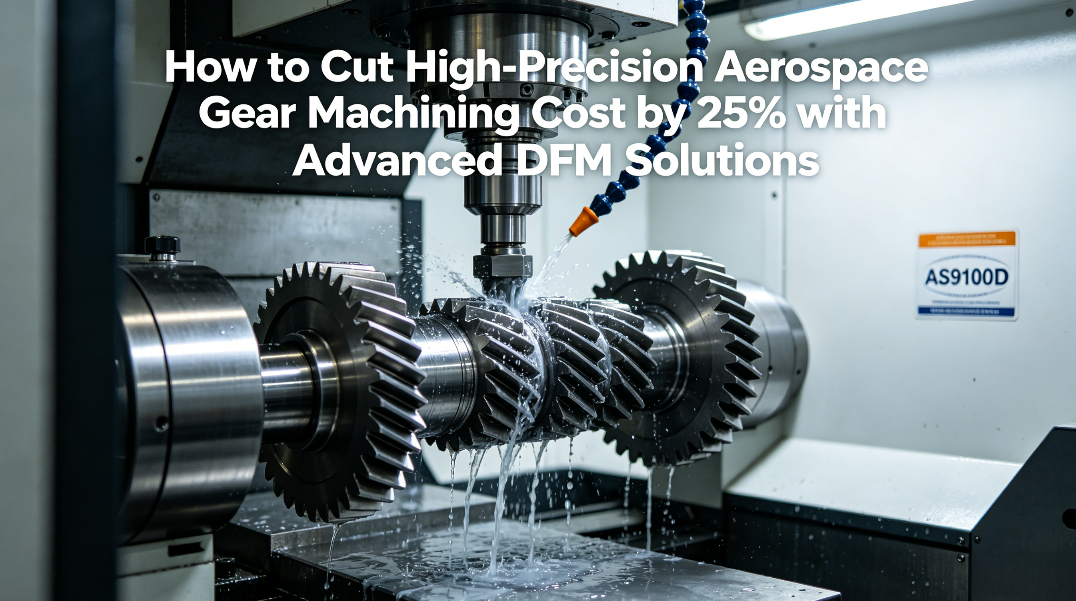
The journey begins with turning the raw material to create a precise gear blank with accurate diameters and faces. This is followed by gear hobbing or shaping, where a rotating cutting tool generates the tooth profile through synchronized motion with the workpiece. For high-precision requirements, gear grinding and honing follow heat treatment, removing minimal material to achieve final tolerances of ISO 5-6 or better. Each step builds upon the previous one, and any deviation accumulates. This is how gear machining works at a professional level — as a closed-loop, controlled process rather than a series of discrete operations.
H3: 2. The Role of Metrology in Process Control
Achieving consistent micron-level precision requires rigorous in-process inspection. Modern gear manufacturing integrates Coordinate Measuring Machines (CMMs) and dedicated gear analyzers to measure tooth profile, pitch, runout, and surface finish at critical stages. Data feeds back to adjust machine parameters in real-time, creating a closed-loop control system. This approach, aligned with NIST smart manufacturing initiatives, ensures that every gear leaving the production line meets the specified accuracy grade, whether AGMA 12 or higher.
H3: 3. Material Science as the Foundation
The choice of material — whether AISI 8620 alloy steel for case-hardened gears, 17-4PH stainless steel for corrosion resistance, or PEEK for lightweight applications — determines the machining strategy, heat treatment requirements, and final performance. Each material responds differently to cutting forces and thermal cycles. A deep understanding of material science allows engineers to select the optimal alloy and specify the appropriate heat treatment (carburizing, nitriding, induction hardening) to achieve the desired balance of surface hardness and core toughness.
H2: Why Is 5-Axis CNC Precision Machining Critical for Complex Custom Gear Profiles?
Non-standard gear geometries — helical, bevel, face gears — demand machining capabilities beyond conventional 3-axis or 4-axis systems. The limitations of multiple setups and cumulative tolerances make 5-axis CNC machining indispensable for high-precision custom gears.
- The Limitation of Conventional Multi-Setup Machining: Traditional 3-axis or 4-axis machining requires multiple setups to complete a complex gear profile. Each repositioning introduces datum shift errors and clamping deformation. For a spiral bevel gear, the cumulative error from three setups can reach ±0.03mm or more — exceeding the allowable tolerance for aerospace applications. This directly impacts gear mesh quality, causing noise, vibration, and premature wear. The inability to maintain a single datum throughout machining is the fundamental limitation of conventional approaches.
- Single-Setup Precision with 5-Axis Technology: 5-axis CNC machining adds two rotational axes (A/C or B/C) to the standard linear motions, enabling the cutting tool to approach the workpiece from virtually any direction. For custom gear manufacturing services, this means the entire gear profile — including complex tooth flanks, undercuts, and internal features — can be machined in a single setup. The single-datum approach eliminates repositioning errors, ensuring that all features are machined relative to one coordinate system. This is critical for maintaining tight Geometric Dimensioning and Tolerancing (GD&T) requirements in the automotive & aerospace manufacturing supply chain.
- Surface Finish and Tool Life Improvements: 5-axis machining allows the tool to maintain optimal engagement angles, using its side cutting edges rather than just the tip. This flank milling technique improves cutting efficiency, surface finish (Ra < 0.4μm), and tool life simultaneously. For thin-walled gear components, the ability to keep the tool short and rigid by rotating the workpiece reduces vibration and allows higher cutting parameters. The result is a gear that not only meets dimensional specifications but also delivers superior performance in terms of noise reduction and load capacity.
H2: How Can Manufacturing Cost Optimization and DFM Reduce Procurement Budgets?
Up to 90% of gear machining costs are determined during the design phase. Unnecessarily tight tolerances, non-standard features, and complex geometries drive up machining time, tooling costs, and scrap rates. Proactive manufacturing cost optimization & DFM intervention can reduce costs by 25% or more without compromising performance.
H3: 1. Identifying Cost Drivers in Gear Design
Common design features that inflate gear machining cost include: unnecessarily tight tolerances on non-mating surfaces (e.g., specifying ±0.005mm on a clearance diameter where ±0.02mm would suffice); sharp internal corners that require specialized tooling or EDM; deep blind holes that demand peck drilling cycles; and non-standard tooth forms that require custom hobs or cutters. Each of these features adds machining time, tooling expense, or scrap risk. A systematic DFM review identifies these cost drivers and proposes alternatives.
H3: 2. Specific DFM Recommendations for Cost Reduction
Practical DFM strategies include: consolidating multiple gear stages into a single integrated component to reduce assembly costs; relaxing tolerances on non-critical features such as hub diameters and face runouts; standardizing keyway and spline dimensions to use standard broaches rather than custom tools; and specifying standard pressure angles (20° or 25°) to avoid custom cutter charges. For low-volume production & rapid prototyping, these optimizations are particularly impactful because tooling amortization is limited.
H3: 3. The DFM Review as a Collaborative Process
A professional DFM analysis is not a one-way critique but a collaborative dialogue between the designer and the manufacturer. The manufacturer’s engineers simulate the machining process, predict potential issues, and propose alternatives that maintain design intent while reducing cost. This is precisely what leading gear machining services providers offer as a standard part of their quoting process. By engaging in DFM early, procurement teams can transform a “build-to-print” transaction into a value-engineering partnership.
H2: What Are the Quality Standards Defining Reliable Contract Manufacturing Solutions?
In global supply chains, quality certifications are the most reliable indicators of a manufacturer’s capability. Beyond equipment, these standards ensure systematic process control, traceability, and continuous improvement — essential for mission-critical aerospace and automotive gears.
H3: 1. ISO 9001: The Foundation of Quality Management
ISO 9001 establishes the baseline for a Quality Management System (QMS). It mandates documented procedures for document control, purchasing, production, inspection, corrective action, and continuous improvement. For Contract manufacturing solutions, ISO 9001 certification means that every process is standardized, audited, and traceable. This translates to predictable quality and consistent delivery performance. The ISO 9001 standard frameworks provide a universal language for quality assurance that transcends geographic and cultural boundaries.
H3: 2. AS9100D: Aerospace-Specific Rigor
AS9100D adds aerospace-specific requirements to the ISO 9001 foundation. It mandates rigorous configuration management, risk management, counterfeit part prevention, and special process validation (e.g., heat treatment, welding, NDT). For gear manufacturing services serving the aerospace sector, AS9100D certification is non-negotiable. It demonstrates that the manufacturer has implemented the highest level of process discipline, ensuring that every gear meets the demanding safety and reliability standards of flight-critical applications.
H3: 3. IATF 16949 and ISO 14001: Complementary Standards
IATF 16949 (automotive) mandates advanced product quality planning (APQP), failure mode effects analysis (FMEA), and production part approval process (PPAP) — tools specifically designed for defect prevention. ISO 14001 (environmental management) demonstrates a commitment to sustainable manufacturing practices. Together, these certifications provide a comprehensive framework for quality, risk management, and corporate responsibility. A manufacturer holding all four certifications has proven their ability to deliver consistent, traceable quality across industries and geographies.
H2: How to Evaluate a Reliable Partner for Your Next Precision Gear Machining Project?
Selecting the right manufacturing partner requires evaluating technical capability, quality systems, and collaborative approach. A systematic evaluation process ensures that the chosen partner can deliver consistent quality, on-time delivery, and continuous improvement.
H3: 1. Assessing Production Capability and Equipment
Begin by evaluating the supplier’s equipment fleet: the number and type of gear cutting machines (hobbers, shapers, grinders), maximum part size, and achievable accuracy grades. For complex gears, multi-axis capability (5-axis CNC) is essential. Also assess their secondary operations — heat treatment, surface finishing, and inspection — to determine if they can manage the entire process in-house. A supplier with integrated capabilities eliminates coordination risks and ensures single-point accountability.
H3: 2. Verifying Quality Systems and Metrology
Request copies of ISO 9001, AS9100D, and IATF 16949 certificates. Ask for sample First Article Inspection Reports (FAIR) and gear inspection reports showing tooth profile, pitch, and runout measurements. Inquire about their inspection equipment — CMMs, gear analyzers, surface roughness testers — and calibration procedures. A partner with robust quality systems will provide objective evidence of their commitment to precision gear machining.
H3: 3. Evaluating Engineering Collaboration and DFM Capability
The best partners do not just execute prints; they challenge assumptions and propose improvements. During the quoting phase, assess their willingness to provide DFM feedback and process optimization suggestions. Do they ask clarifying questions about the application? Do they recommend material or tolerance adjustments? A partner that invests in understanding your project is one that will deliver superior results. This collaborative approach is the hallmark of a true custom gear manufacturing partner, transforming a transactional relationship into a strategic alliance.
H2: How to Gain an Accurate Gear Machining Quote for Time-Sensitive Engineering Projects?
Obtaining a precise, competitive gear machining quote quickly requires preparing a complete technical package and engaging with a responsive, digitally-enabled supplier. This accelerates the procurement cycle and eliminates costly misunderstandings.
- Preparing a Complete Inquiry Package: The foundation of an accurate quote is a complete technical submission. This should include: a 3D CAD file (STEP or IGES format) showing the full gear geometry; a 2D drawing (PDF or DWG) with all dimensions, tolerances, and GD&T callouts; material specifications (grade, hardness, heat treatment requirements); surface finish requirements (Ra value); and annual volume projections. The more complete the package, the more accurate and faster the quote.
- The Role of Digital Quoting Platforms: Modern gear manufacturing services providers use digital quoting platforms that analyze the uploaded CAD file automatically. The system identifies features like tooth count, module, helix angle, and internal splines, then cross-references them against a database of material costs, machine capabilities, and tooling requirements. Within hours, it generates a detailed quote with a transparent cost breakdown. This speed enables rapid iteration: engineers can modify their design and immediately see the cost impact.
- Evaluating Quotes Beyond Price: When comparing quotes, look beyond the bottom line. Evaluate the supplier’s DFM feedback, quality certifications, proposed lead time, and payment terms. A slightly higher quote from a certified, technically engaged supplier often represents the lowest total cost when factoring in quality, reliability, and delivery performance. The goal is not the cheapest gear, but the most reliable, cost-effective solution for your application.
H2: Conclusion
In summary, achieving cost-efficient procurement of high-precision gears depends not only on advanced 5-axis CNC machining hardware but also on integrating DFM optimization thinking into the supply chain from the earliest design stage. By streamlining unnecessary processing steps and selecting a certified contract manufacturing partner with systematic quality assurance, global engineering enterprises can successfully achieve up to 25% cost optimization while ensuring products meet the most stringent standards.
H2: FAQs
Q1: What is the standard lead time for low-volume precision gear manufacturing services?
A: Lead times typically range from 7 to 15 days, largely depending on geometry complexity, required heat treatments, and specific surface finishes tailored for industrial automation supply chains.
Q2: How does 5-axis CNC machining improve custom gear quality compared to traditional methods?
A: It allows single-setup machining of complex profiles, eliminating human errors and cumulative tolerances caused by multiple relocations, thereby ensuring superior pitch and concentricity.
Q3: Which design factors have the greatest impact on reducing overall gear machining cost?
A: Minimizing overly tight geometric tolerances on non-mating surfaces, avoiding blind holes, and reducing deep internal splines will significantly optimize manufacturing efficiency and costs.
Q4: Why are ISO 9001 and AS9100D certifications vital for aerospace contract manufacturing solutions?
A: These certifications guarantee strict traceability, comprehensive risk management, and rigorous quality inspection protocols, ensuring that every batch meets absolute safety and performance standards.
Q5: What file formats are required to secure an efficient and accurate gear machining quote?
A: Engineering teams should submit 3D CAD files (STEP or IGES format) alongside detailed 2D drawings that specify exact tolerances, materials, heat treatment parameters, and surface finish options.