




Choosing a campsite in Italy for a family holiday is, more than most parents care to admit, an act of faith. You browse photographs, read reviews that contradict each other with impressive confidence, compare prices that reveal nothing about what actually awaits. Then you press confirm and hope for the best. The good news is that this process does not have to rely on optimism. There are objective criteria that transform a gamble into a decision, criteria that apply regardless of destination, budget or the age of the children in tow. For anyone searching for the right holiday camping in Italy for children, what follows is the checklist that should have existed before you started looking.
The First Question to Ask: How Child-Friendly Is the Beach?
Everything begins with the sea. Not the accommodation, not the water park, not the evening entertainment programme: the sea. It is the first thing children see when they arrive and the last thing they remember when they leave, and it conditions every single day of the holiday more than any other variable.
The right question is not whether there is a beach. It is what kind of beach. The shallow, sandy seabed of the Adriatic, which extends for tens of metres before reaching any significant depth, is structurally different from the rocky or steeply shelving shores found elsewhere along the Italian coast. With young children, that difference is not aesthetic. It is the difference between a sea where you can actually relax and one where you never stop watching.
A private beach is the second element worth verifying before anything else. Eliminating the daily logistics of finding space on a crowded public stretch of sand is worth, with children in tow, as much as almost any other service a facility can offer. Anyone who has spent a single August morning hunting for available sun loungers under a beating sun understands immediately what is at stake. The Adriatic coast of Emilia Romagna, and the Lidi Ferraresi in particular, answers both requirements better than almost any other stretch of Italian coastline: safe, shallow water, wide and well-organised beaches, infrastructure built around family needs rather than retrofitted to accommodate them.
The Water Park: Why It Makes or Breaks a Family Holiday
The water park has become, in recent years, the most frequently cited selection criterion among families travelling with children between five and fourteen. This is not a generational quirk. It is a rational response to a genuine need. Children require movement, stimulation, something that extends beyond the horizon of an umbrella and a patch of sand. A well-run water park resolves this problem effectively, safely and without requiring parental improvisation.
Not all water parks are equal, and the differences matter considerably. The first element to verify is access: reserved exclusively for guests of the facility, or open to external day visitors as well? The answer determines queue lengths, crowding levels and the overall quality of the experience in ways that no brochure will mention. The second is operating hours: a park that closes in the early afternoon leaves the hottest part of the day uncovered, precisely when children have the greatest need for structured activity. The third is the safety framework: minimum height requirements for slides, staffing levels, clear rules on adult accompaniment of minors.
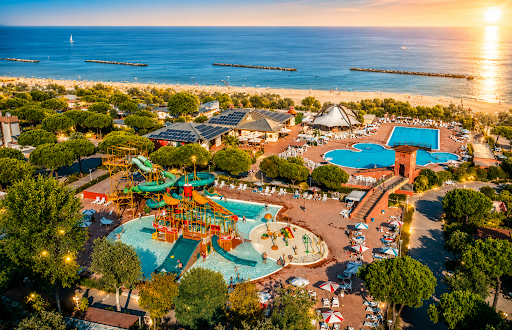
A family camping with water park such as Holiday Park Spiaggia e Mare answers these criteria with the kind of concrete precision that families should demand before confirming any booking: guest-only access, operation from 10:00 to 19:00, slides with differentiated minimum height requirements, 120 cm for the Kamikaze and Giant Slide, 110 cm for the Hydrotube, free entry for children up to three years of age, a seasonal bracelet at €22 in high season included in the stay during low season, sun loungers and parasols provided as standard. Figures that leave no room for ambiguity, and that are exactly the kind of information a family is entitled to have before committing.
Accommodation That Works for the Whole Family, Not Just the Adults
The right accommodation for a family with children is not simply the largest available or the most economical. It is the one designed with a genuine understanding of how a family actually occupies space during a holiday, how mornings unfold, where meals happen, where children play when the sun is too strong for the beach.
Floor area is the first indicator. Below 30 square metres, with two adults and two children, the space begins to assert itself by the second day in ways that erode patience faster than any missed flight. Quality facilities offer considerably more: mobile homes of 32 to 37 square metres, with two separate bedrooms, a fully equipped kitchen, a bathroom and an outdoor veranda. The kitchen is not a luxury. It is the concrete answer to breakfast before the beach, afternoon snacks, and the evenings when going out is simply not on the agenda.
The veranda deserves particular attention. It is the space that, in a seaside holiday, sees more use than any other: breakfast in the open air, a light lunch in the shade, children’s games in the late afternoon when the sun begins to soften. In some accommodation models, the veranda comes with a slide built directly into its structure, a detail that says more about a facility’s understanding of its audience than any marketing claim could.
Glamping tents, with floor areas reaching 56 square metres across two floors, answer a different need: more space, more atmosphere, the outdoor experience without sacrificing a proper bed or a private bathroom. The choice between a mobile home and a glamping tent is not a question of budget but of holiday philosophy. In the best facilities, both options are designed for families with equal seriousness and care.
The Services That Parents Actually Need
There is a mental checklist that every parent assembles before departure, usually without quite realising it. A restaurant with a menu that children will accept without extended negotiation. A minimarket for the things inevitably left behind. An entertainment programme that delivers a genuine hour of rest in the afternoon rather than the watchful half-relaxation that parents of young children know too well. A bike hire centre for exploring the coast without loading bikes, children and equipment into a car that is already at capacity.
These are not optional extras. They are the difference between a holiday that flows and one that grinds. A camping village that provides all of them within a single, coherent setting reduces daily logistics to a minimum. And with children, logistics are always the variable that determines the quality of a week away more reliably than any headline attraction.
A restaurant open for lunch and dinner, with a dedicated children’s menu and half-board arrangements for those who prefer not to think about meals, resolves the evenings when cooking is not a realistic option. A bar running from 7:30 to 23:00 resolves breakfast, the morning coffee and the evening aperitivo. Pet-friendly policies resolve the problem of those who cannot leave the dog behind. Electric vehicle charging points resolve a need that grows with every passing season. Beach service included for accommodation guests resolves the logistics of the shoreline itself. Individually, these are details. Collectively, they are the holiday.
Getting There with Children: Airports, Transfers and the Journey Itself
The final criterion is the most pragmatic, and frequently the most underestimated: how you actually get there with children in tow. For a British family, the journey is part of the holiday, and a trip that starts well tends to set the tone for the whole week.
The starting point is the airport. Bologna is the natural gateway to the Ferrara and Emilia Romagna coastline, served by direct flights from London Heathrow with British Airways and from London Luton and Stansted with Ryanair: no connections, no intermediate transfers, which with children matters far more than it does without. It is worth knowing, too, that the main London airports offer facilities designed for families travelling with young children, from dedicated family lanes at security to play areas that let children burn off energy before boarding. Knowing what your departure airport provides turns the pre-flight wait from an ordeal into a manageable interval.
Arrival in Bologna is straightforward. The airport gives the youngest travellers a fast lane through security, sparing families the draining queue that weighs twice as heavily with little ones in tow. From there, a hire car is the most convenient way to reach the Lidi Ferraresi, an easy drive with rental agencies available directly at the terminal. For those who would rather not drive after a flight, a direct shuttle links the airport to the centre of Ferrara in around an hour, with onward connections to the coast.
One practical point outweighs the rest: timing the booking. The beachfront mobile homes and sea-view glamping tents at the most sought-after facilities are claimed months before summer arrives, and the families who secure them tend to be those who decide early. On this coast, the best of the season is reserved in winter, long before most people begin to look.