




Long before a single display case gets built, every great museum exhibit starts as a concept — a visual sense of how a story will unfold as visitors walk through a space. Pitching that concept convincingly used to require expensive architectural renderings or a skilled illustrator on staff.
An AI image maker makes exploring these concepts dramatically more accessible, and Dreamina is particularly effective at rendering the kind of atmospheric, spatially convincing scenes that help a historical theme feel like an actual place someone could walk into.
Here’s how to pitch an exhibit before a single wall goes up.
Why a museum exhibit needs a visual concept before a single case is built
Exhibit design is fundamentally spatial and emotional — visitors need to feel something as they move through a themed space, not just read information plaques.
A visual concept lets curators, designers, and funders actually see and react to that emotional journey long before expensive construction begins.
Choosing a historical theme with real visual potential
Some historical themes translate more naturally into compelling visuals than others. Strong candidates usually involve distinctive artifacts, dramatic lighting opportunities, or a clear narrative arc visitors can follow.
- A theme with strong, recognizable artifacts or imagery
- A story with a clear beginning, turning point, and resolution
- An era with a distinct visual aesthetic worth recreating
Designing a layout that guides visitors through a story
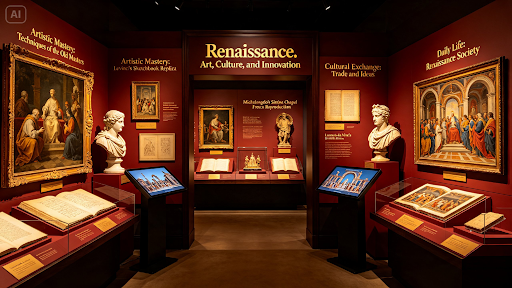
The strongest exhibit concepts consider the visitor’s physical path through the space, not just individual display moments. Describing this progression — a dim entrance building anticipation, a bright central reveal, a reflective closing area — helps a concept feel like a genuine spatial experience.
Dreamina and its image generation capabilities
Dreamina gives exhibit designers access to a range of image generation models, and Seedream 5.0 Pro, the newest and most advanced option, is particularly effective for this kind of spatial, atmospheric work. It handles complex lighting scenarios especially well — dramatic spotlighting on a central artifact, softer ambient light guiding visitors through a corridor — while keeping architectural elements like walls, cases, and signage consistent across a full concept image.
Nano Banana offers faster generation for testing a few different layout or lighting directions before committing to a detailed final render, while GPT Image 2 handles prompts describing several specific exhibit elements together closely, useful for busier, multi-zone concept scenes.
Turn a theme into an exhibit concept in three moves
Dreamina makes producing pitch-ready exhibit visuals genuinely achievable without an architectural rendering budget.
Step 1: Enter a text prompt
Open Dreamina and describe your exhibit concept in detail, including theme, lighting, and the specific moment or artifact you’re visualizing. Upload reference images of similar exhibit styles if you have them.
For instance: A museum exhibit concept illustration of a person dressed as a museum curator arranging a timeline wall of historical photographs, moody spotlighting, highly detailed architectural rendering.
Step 2: Adjust parameters and create
Select Image 5.0 Pro, powered by Seedream 5.0 Pro, for atmospheric lighting and consistent spatial detail, then set your aspect ratio, canvas size, and resolution — 1K for early concept exploration, 2K for polished pitch presentations. Click the generate icon to render your concept.
Step 3: Refine and download
Refine the result using Dreamina’s tools: inpaint to adjust specific display or lighting details, expand to reveal more of the surrounding exhibit space, remove to clean up distracting elements, and retouch for a final presentation-ready finish. Once it’s ready, click Download.
Create multiple exhibit concepts for comparison
Exploring several visual directions helps you discover how the same historical theme can create different visitor experiences. Try variations with immersive projections, traditional display cases, reconstructed environments, or interactive artifact stations. Comparing these concepts makes it easier to discuss layout, atmosphere, and storytelling with collaborators before settling on a final design.
Add details that make the exhibit feel authentic
Small environmental elements can give a museum concept greater realism. Include period-inspired textures, carefully arranged artifacts, appropriate display materials, and subtle visitor pathways. These details help communicate how the exhibit might function while giving stakeholders a clearer picture of its intended atmosphere and educational purpose.
Balancing artifacts with atmosphere and lighting
An exhibit concept succeeds when the environment itself contributes to the storytelling, not just the objects on display. Describing specific lighting moods, material choices for walls and cases, and even ambient details like dust or texture helps a concept feel genuinely atmospheric rather than clinical.
Using scale models and mockups to pitch the idea
Beyond full-scale renders, generating a concept that reads like a physical scale model can be especially persuasive in early pitch meetings, giving stakeholders an intuitive sense of proportion and flow before committing to full architectural planning.
Designing signage and interpretive panels that fit the mood
Even at the concept stage, considering how signage and interpretive text will visually integrate into the space — rather than treating it as an afterthought — helps the overall pitch feel more complete and genuinely considered.
Where these exhibit concepts get used
Concept art built this way supports real museum and cultural project work:
- Grant applications and funding pitch materials
- Internal design reviews and stakeholder presentations
- Marketing previews building public anticipation
- Student and academic exhibition design portfolios
Bring the story to life before the walls go up
A compelling exhibit concept can be the difference between a pitch that gets funded and one that doesn’t. With Dreamina and the atmospheric precision of AI algorithms, turning a historical theme into a genuinely persuasive visual concept is fast, accessible, and free to start exploring today.