




In an era where operational budgets are under constant pressure and sustainability goals are reshaping procurement strategies, industrial facilities across the globe are rethinking how they source critical process equipment. Among the most significant shifts is the growing preference for pre-owned thermal management solutions. Heat exchangers — the workhorses of chemical plants, refineries, food processing facilities, and power generation units — represent a major capital expenditure when purchased new. As a result, procurement managers and plant engineers are increasingly exploring the secondary market as a viable, intelligent alternative.
The Role of Heat Exchangers in Industrial Operations
Heat exchangers are fundamental to virtually every process-intensive industry. Their primary function is to transfer thermal energy between two or more fluids without allowing them to mix — a seemingly simple task that underpins the efficiency of entire production systems. Whether it is cooling a reactor, recovering waste heat from exhaust streams, or pre-heating feedstock before it enters a distillation column, the heat exchanger sits at the heart of energy management within a plant.
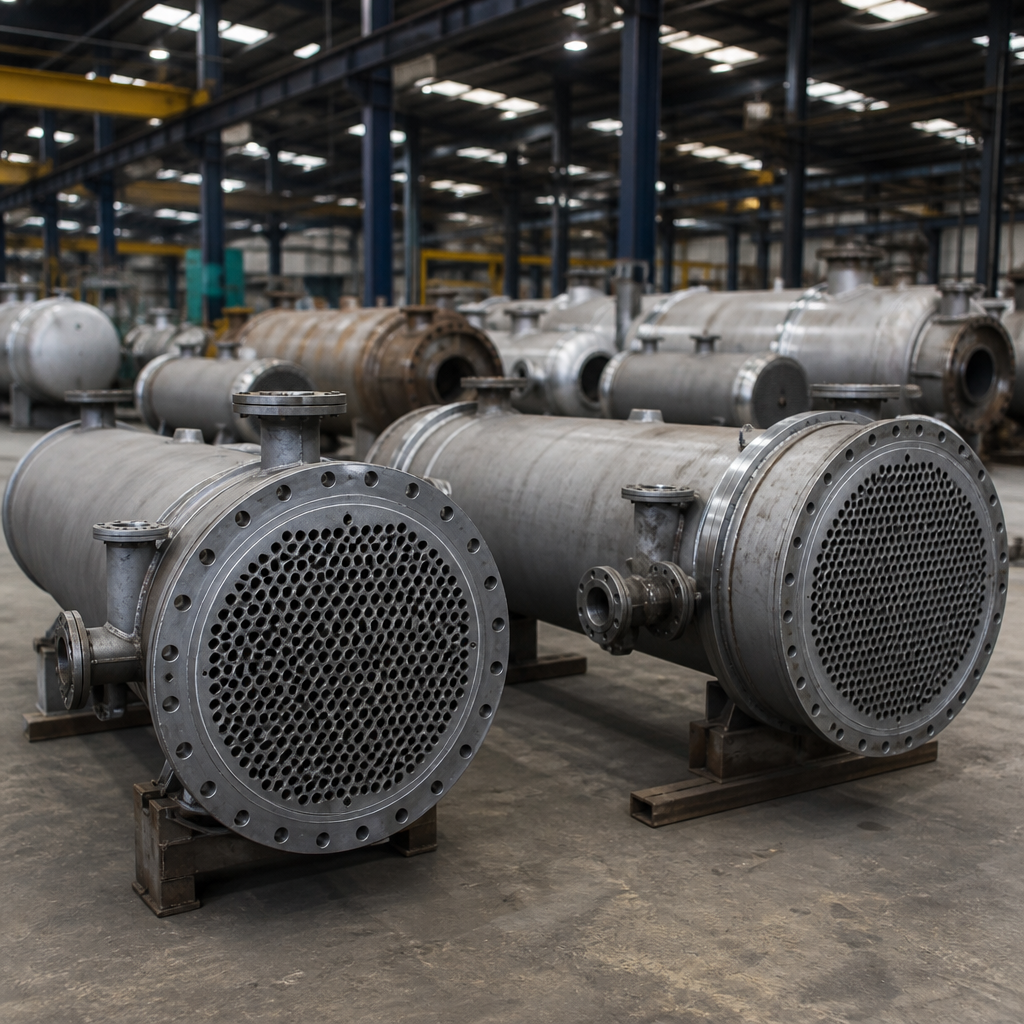
The variety of configurations available — shell-and-tube, plate-and-frame, air-cooled, spiral, and double-pipe designs — means that heat exchangers are engineered to meet highly specific process conditions. Pressure ratings, material compatibility, surface area, and flow arrangement all factor into the selection process. This complexity is precisely why sourcing the right unit at the right price can be a significant challenge for facility operators working within tight capital budgets.
Capital Costs vs. Operational Value
A new shell-and-tube heat exchanger designed for high-pressure refinery service can cost hundreds of thousands of dollars, depending on its size and material specifications. For smaller operations or facilities undergoing rapid expansion, this level of capital outlay can be prohibitive. The secondary equipment market offers a compelling alternative — units that have been decommissioned from other facilities, often with substantial service life remaining, available at a fraction of the original cost.
This is not a compromise in quality. Many pre-owned units are removed from service not because they have failed, but because a plant has been shut down, retooled, or upgraded to a different process configuration. The equipment itself may be in excellent mechanical condition, having been maintained to strict industry standards throughout its operational life.
Sourcing Pre-Owned Equipment: What to Look For
Purchasing used process equipment requires due diligence. Unlike commodity goods, industrial heat exchangers carry process histories that must be thoroughly evaluated before redeployment. Buyers should request documentation including previous service conditions, inspection records, material certifications, and any repair or re-tubing history. Reputable suppliers will provide this information transparently and may also offer refurbishment services to bring a unit back to specification before delivery.
Non-destructive testing methods — such as ultrasonic thickness measurement, hydrostatic pressure testing, and eddy current inspection of tube bundles — are standard tools used to assess the integrity of a pre-owned unit. Facilities that invest in this level of evaluation before purchase significantly reduce the risk of unexpected failures after installation.
Matching Equipment to Process Requirements
One of the most important considerations when sourcing a pre-owned heat exchanger is ensuring that the unit’s specifications align with the intended application. This includes verifying the design pressure and temperature ratings, the materials of construction (particularly for corrosive or high-purity services), the heat transfer surface area, and the connection sizes and orientations. Working with an experienced equipment supplier who understands process engineering fundamentals is essential to making the right match.
The Broader Context: Energy Efficiency and Industrial Sustainability
The push toward greater energy efficiency in industrial operations is not merely a cost-driven initiative — it reflects a broader global commitment to reducing the carbon footprint of manufacturing and processing industries. Heat recovery systems, of which heat exchangers are a central component, play a direct role in reducing fuel consumption and greenhouse gas emissions. By capturing and reusing thermal energy that would otherwise be lost, facilities can dramatically improve their overall energy efficiency ratios.
This principle extends beyond individual plants. On a macro scale, advances in nuclear energy — such as the development of China’s 1,200 MW nuclear reactor currently undergoing cold testing — highlight the global emphasis on scalable, low-emission energy generation. Industrial heat management technologies, including heat exchangers, will remain critical infrastructure as energy systems evolve toward cleaner sources.
Parallels with Residential Fluid Management Systems
The importance of reliable fluid and thermal management is not exclusive to large industrial settings. At the residential level, homeowners are increasingly recognizing the value of dependable mechanical systems that protect their properties from water damage and inefficiency. Much like industrial operators who depend on heat exchangers to maintain process stability, understanding the importance of a reliable sump pump system is a critical aspect of responsible home ownership. The underlying principle is the same: proactive investment in the right equipment prevents costly failures down the line.
International Process Plants: A Trusted Source for Pre-Owned Process Equipment
For facilities seeking reliable access to pre-owned thermal management equipment, working with a specialist supplier makes all the difference. International Process Plants has established itself as a leading resource in the secondary process equipment market, offering an extensive inventory of decommissioned and surplus industrial equipment sourced from facilities around the world. Their team brings deep technical knowledge to every transaction, helping buyers identify units that meet their specific process requirements and budget constraints.
The company’s inventory spans a wide range of industries and equipment categories, with a particular strength in thermal and separation equipment. Their approach combines rigorous equipment assessment with transparent documentation, giving buyers the confidence they need to make informed procurement decisions. Whether a facility requires a single replacement unit or is outfitting an entire new process train, International Process Plants offers the depth of inventory and expertise to deliver.
Making the Case for the Secondary Equipment Market
Sourcing a used heat exchanger from a reputable supplier is a decision that can deliver substantial financial and operational benefits. Lead times for new custom-fabricated equipment can stretch to many months, creating bottlenecks for facilities that need to move quickly. Pre-owned units, particularly those already in inventory, can be inspected, purchased, and delivered in a fraction of that time — a critical advantage for plants managing unplanned outages or accelerated project timelines.
Beyond speed and cost, there is an environmental argument to be made as well. Extending the useful life of industrial equipment reduces the demand for raw material extraction and manufacturing energy associated with producing new units. In this sense, the secondary equipment market aligns naturally with circular economy principles that are becoming increasingly central to corporate sustainability strategies.
Conclusion
The decision to source pre-owned heat exchangers is no longer a fallback position for budget-constrained operations — it is an increasingly mainstream strategy embraced by sophisticated industrial buyers who understand the value of quality equipment at competitive prices. With the right supplier, the right due diligence process, and a clear understanding of process requirements, facilities can achieve excellent thermal management outcomes without the capital burden of new equipment procurement. As energy efficiency and sustainability continue to drive industrial decision-making, the secondary process equipment market will only grow in relevance and importance.