





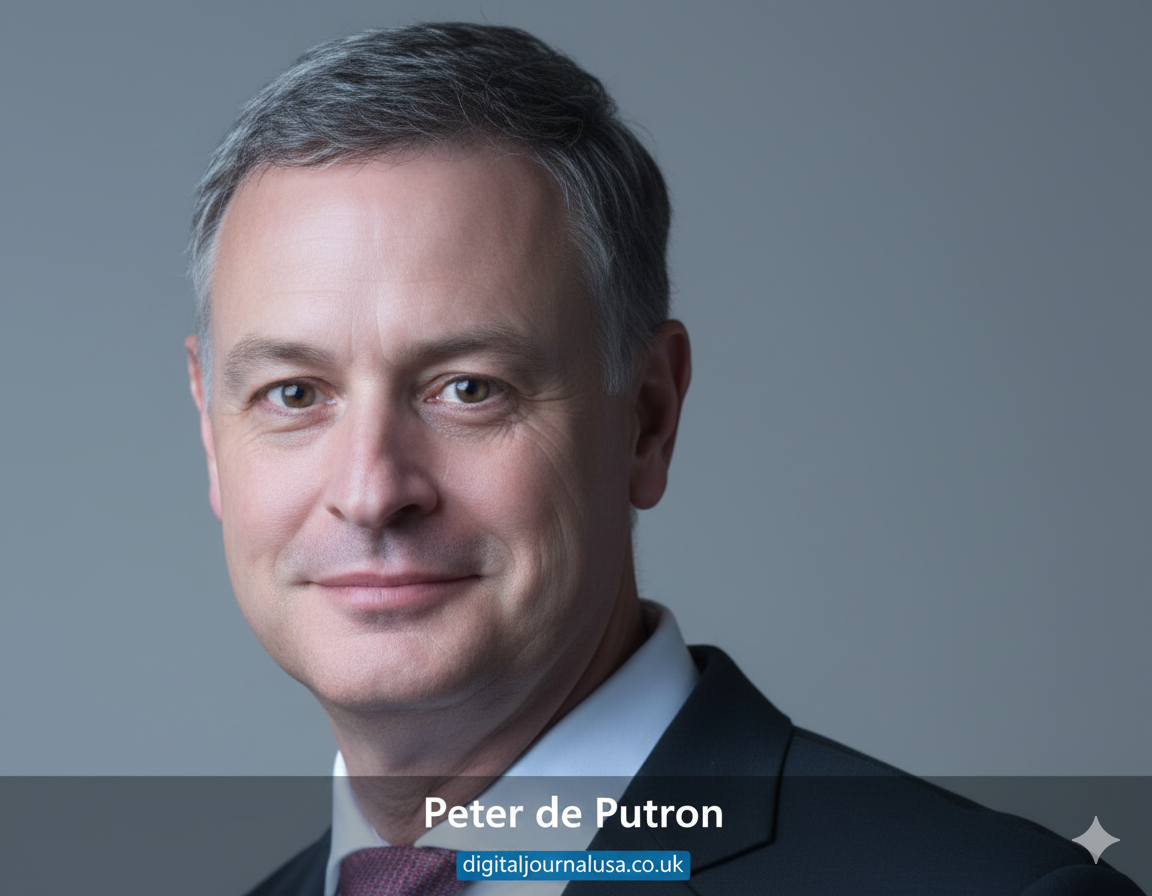
Peter de Putron, a name that often arises in circles discussing finance, politics, and motorsports, is one of the most enigmatic figures of the modern financial world. Despite his influence, he maintains a remarkably private life, leaving many aspects of his background, wealth, and professional dealings open to speculation. His business ventures, particularly in hedge funds and quantitative finance, his political connections, and his potential influence over the Williams Formula 1 team, place him at the crossroads of power, wealth, and secrecy.
This article aims to delve into the complex web of Peter de Putron’s career, examining his early life, his business empire, his personal life, and the controversies surrounding him.
Peter de Putron Early Life and Education
Peter Nicholas de Putron was born on October 15, 1963, in Guernsey, a small island in the English Channel, which is known for its status as a tax haven and its distinctive local governance. De Putron grew up in an environment that was heavily influenced by finance and politics. His family had longstanding ties to the island’s financial scene, setting the stage for his future career.
De Putron’s educational path is typical of many in the elite financial world. He attended Eton College, one of the most prestigious schools in the United Kingdom, known for educating many of the country’s most influential individuals. After Eton, he pursued a degree in Engineering Science at Jesus College, Oxford, where he honed his analytical skills — a foundation that would prove crucial in his later career in quantitative finance. De Putron furthered his education with an MBA from the Wharton School at the University of Pennsylvania, where he specialized in finance and entrepreneurial management, solidifying his future in the business world.
The Early Career of Peter de Putron
Peter de Putron’s professional journey began in the world of corporate finance in the mid-1980s. His early career saw him working with major financial institutions, including the Royal Bank of Canada in corporate finance, and GNI Brokerage in London, where he delved into the complexities of derivatives trading. By the early 1990s, he had joined IFM, a London-based hedge fund, where he began to refine the strategies that would later define his approach to investment. These experiences in the financial world helped him develop a deep understanding of market structures, trading strategies, and risk management.
In 1997, Peter de Putron took a significant step toward independence by founding De Putron Fund Management. This hedge fund was initially focused on managing the wealth of high-net-worth individuals and institutional clients. The fund specialized in a range of financial strategies, including market-neutral and event-driven strategies, gaining a reputation for generating strong returns with relatively low volatility.
G-Research: A Quantitative Finance Powerhouse
However, De Putron’s most significant contribution to the finance world came with the founding of G-Research in 2001. Originally named Gloucester Research, G-Research is a quantitative finance and research firm that specializes in algorithmic trading and data-driven investment strategies. The company uses complex mathematical models and cutting-edge technology to predict market movements, a venture that put De Putron at the forefront of the growing field of quantitative finance.
G-Research’s success has been driven by its ability to leverage big data, machine learning, and high-frequency trading algorithms to outpace traditional investment strategies. The firm has built a reputation as one of the leading players in the field of algorithmic trading, and while it manages a significant amount of capital, it is known for being highly secretive about its operations. Although specific financial details are often shielded from public view, it is widely believed that G-Research is one of the most profitable hedge funds in the world.
De Putron’s control over G-Research has been crucial in its success. The firm operates largely as a family office, managing De Putron’s own wealth and investments. The company has grown to employ over 1,000 people, many of whom have backgrounds in mathematics, physics, and computer science, underscoring the firm’s reliance on quantitative analysis and technological innovation.
Bell Rock Capital Management: Activist Investor
In addition to G-Research, De Putron is linked to Bell Rock Capital Management, an investment firm known for its activist investment strategies. Bell Rock focuses on influencing the management of companies in which it invests, often pushing for changes in corporate governance or strategic direction. The firm has been involved in a number of high-profile campaigns, including its activist efforts in the Australian coal industry, where it sought changes in the management of Whitehaven Coal. This type of activist investing is a hallmark of De Putron’s approach, combining financial expertise with a hands-on strategy to shape corporate outcomes.
While much of the detail surrounding Bell Rock remains opaque, the firm is another arm of De Putron’s investment empire, allowing him to extend his influence in the corporate world beyond the financial markets.
Political Ties and Influence: The Andrea Leadsom Connection
Peter de Putron’s business ventures are not the only area where he wields influence. He has developed significant political connections, particularly in the United Kingdom. One of the most notable is his relationship with Andrea Leadsom, a senior figure in the Conservative Party and a former cabinet minister.
Leadsom is married to Hayley Salmon, De Putron’s wife, making De Putron and Leadsom brothers-in-law. This familial connection has given De Putron a pathway into the world of British politics, where he has made significant financial contributions to the Conservative Party. Through his offshore structures, De Putron has donated large sums to the party, and his involvement in political donations has drawn attention due to the relatively opaque nature of his financial dealings in the Channel Islands.
Critics have raised concerns about the influence that such donations, often funneled through complex corporate vehicles, have on political decision-making. The Brexit debate, in particular, saw De Putron’s name linked to Eurosceptic causes, further fueling speculation about his political ambitions and influence.
The Williams Formula 1 Connection: A Mysterious Stakeholder
Perhaps one of the most intriguing aspects of Peter de Putron’s life is his potential involvement with Williams Formula 1, a team that has a long and storied history in motorsport. In 2020, Williams Racing was sold to a private investment group called Dorilton Capital. While the sale was publicly attributed to Dorilton, there have been persistent rumors that De Putron may be the true owner or at least have significant control over the team.
According to court documents and legal filings, De Putron has been linked to the team through complex holding structures. He is often referred to internally by the team as “ODL”, which some believe stands for “Our Dear Leader” — a reference that suggests his influence over team management. While Williams and Dorilton have denied these claims, the connection between De Putron and Williams F1 remains a topic of speculation among Formula 1 fans and insiders. De Putron’s exact role in the team, whether as an investor or a behind-the-scenes operator, is unclear, but his potential influence over one of the most famous motorsport teams in the world adds another layer to his already complex profile.
Peter de Putron Net Worth and Wealth
Estimating Peter de Putron’s net worth is challenging due to his use of offshore trusts and private corporate entities. However, it is widely believed that he is a billionaire, with his wealth largely stemming from his successful hedge fund ventures and control over G-Research. Some estimates suggest his wealth could exceed several billion dollars, although these figures are speculative given the secrecy surrounding his financial empire.
While the exact number remains elusive, De Putron’s wealth places him among the upper echelons of the global financial elite. His assets are spread across multiple sectors, from quantitative finance and hedge funds to real estate and motorsport.
Peter de Putron Personal Life and Family
Peter de Putron is a private individual who avoids media attention. Unlike many of his peers in the business world, he has no public social media presence, and there are very few publicly available photographs of him. He lives in Jersey, an offshore tax haven that allows him to maintain privacy while also benefiting from the favorable tax structures the island offers.
He is married to Hayley Salmon, with whom he has four children. His family life is kept under wraps, and there is little publicly known about his personal relationships beyond his professional connections.
De Putron’s brother-in-law, Andrea Leadsom, is a well-known figure in UK politics, and their relationship has fueled speculation about De Putron’s role in shaping political outcomes, especially through financial donations and influence.
Controversies and Criticism
While De Putron’s business acumen is undeniable, his methods and the secrecy surrounding his operations have led to criticism. His use of offshore financial structures, particularly in Guernsey and Jersey, has raised questions about his tax practices. Moreover, his political donations, which have been channeled through complex corporate vehicles, have fueled concerns about the influence of wealth on political decision-making.
The Williams Formula 1 team saga also adds an element of mystery to his public image. While Williams and Dorilton have denied any direct involvement by De Putron, the persistent rumors about his behind-the-scenes role suggest that there may be more to the story than what is publicly acknowledged.
Conclusion
Peter de Putron’s life is a testament to the power of private wealth, financial acumen, and strategic influence. His career spans multiple industries, from quantitative finance and hedge fund management to political donations and potential ownership of a major Formula 1 team. His ability to stay largely out of the public eye, while controlling vast amounts of wealth and influence, has cemented his place as one of the most fascinating yet mysterious figures in the financial world today.
Despite the ongoing speculation and scrutiny surrounding his business dealings and political connections, Peter de Putron remains a figure who operates in the shadows, shaping industries and political landscapes without ever seeking the limelight.