




Three months of daily use in a real UK home — what the spec sheet doesn’t tell you
Most standing desk reviews are written after a week. Some are written after a day. The reviewer unpacks the desk, assembles it, raises and lowers it several times, writes about first impressions, and publishes. What those reviews cannot tell you — what only time can tell you — is whether the motor still sounds the same at month three as it did on day one. Whether the wood surface shows wear after ninety days of daily use. Whether the sit-stand habit that felt novel in week one has become automatic by month two, or whether it quietly dissolved somewhere around week three.
This is a ninety-day review of the Julia standing desk from Hulala Home. I assembled it on a Monday morning in a first-floor Victorian terrace room that I use as a study, and I have used it every working day since. What follows is the account that ninety days of daily use produces — including the things I got wrong in my initial assessment, the things that exceeded my expectations over time, and the one honest limitation that has not changed since day one.
The Setup: Room, Context, and Starting Scepticism
The room: first-floor Victorian terrace, 3.2 metres by 3 metres, 2.7-metre ceiling. Sash windows facing south-east — strong morning light, limited afternoon light. Wooden floorboards in a warm honey tone, walls in a warm off-white. Built-in shelving on one wall, cast-iron fireplace opposite. It is the kind of room where everything that enters it is evaluated against an accumulated visual standard, and most things fail.
What I was replacing: a Victorian pine writing desk — solid, beautiful, fixed at a height I had never questioned. The decision to replace it was driven by two years of increasing neck and upper shoulder tension that my physiotherapist had attributed, plainly, to six hours a day at a fixed seated height. I was not sceptical about the ergonomic case for a standing desk. I was sceptical about whether anything motorised and height-adjustable could be placed in a room this particular without looking like it had been relocated from an office.
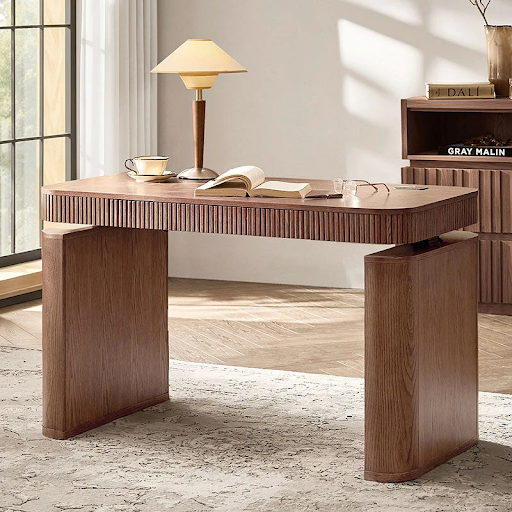
The spec I ordered: Julia in Cocoa Walnut finish, 121cm wide, 65cm deep, height range 77.5cm to 123cm. The width was the decisive practical choice — 121cm accommodates a single 27-inch monitor on an arm plus a laptop stand with enough peripheral space to work comfortably. The Cocoa Walnut finish was chosen to sit alongside the existing wood tones in the room rather than against them.
Month One: Assembly, First Impressions, the Learning Curve
Assembly: 15–30 minutes with a second person for the frame attachment step. The instructions are printed, clear, and sequenced correctly. The one step requiring two people is holding the frame level while tightening the bolts — not difficult, but not manageable alone without patience and improvisation. I would strongly recommend having a second pair of hands.
First visual impression: better than the product photographs suggested, which is the reverse of the usual experience. The Cocoa Walnut surface in the morning light coming through the south-east window had a depth and warmth that the photographs — taken in controlled studio lighting — had not fully conveyed. The clean square edge of the tabletop read as furniture-grade precision. Against the wooden floor and the off-white walls, it looked as though it belonged there. I had not expected that. I wrote it down.
The built-in drawer: used from day one. Phone, small notebook, earphones, a lip balm that had been taking up surface space for three years. The surface was clear within the first morning. This is a detail that sounds trivial and turns out to matter considerably for the quality of the workspace.
The standing habit in month one: inconsistent. I stood in the morning for the first few days — novelty-driven — and then fell back to sitting for most of each day by the end of week one. I used the standing function perhaps once or twice a day through weeks two and three. The memory presets, which I had calibrated on day two, made each transition a single button press and four seconds of motor travel — but even so, the habit was not yet instilled. Month one is not when the standing habit forms. It is when the physical calibration happens.
What I got wrong in my initial assessment: I underestimated how much the drawer would matter and overestimated how quickly the standing habit would form. Both of these corrected themselves by month two.
Month Two: The Habit Test
Month two is when a standing desk either becomes a permanent working tool or reverts to an expensive fixed-height desk. The determining factor — in my experience and, I suspect, in most people’s — is whether the preset system removes enough friction from the transition that standing up becomes a reflex rather than a decision.
For me, the shift happened in the third week of month two, during a period of particularly concentrated work. I found myself raising the desk at the start of sessions that required full focus and lowering it during reading and reviewing — not because I had decided to, but because the physical transition had started to carry psychological meaning. The gear-change sensation I had noticed in week one had become automatic. I was alternating three to four times per day without recording it or tracking it.
Motor reliability at month two: unchanged from day one. The same smooth four-second travel, the same low hum at approximately 40–45dB. I ran a specific noise test in week six: motor adjustment at 6.45am with the house otherwise completely quiet. Heard clearly from the room it was in. Inaudible from the adjacent room. The party wall test has been passed consistently.
Surface condition at month two: no visible wear. The wood surface — which I had been treating with a certain amount of care, partly from instinct and partly from the awareness that I was reviewing it — showed no scratching, no marking from the mouse pad, no degradation of the finish at the edges where hands rest. It looked, at the end of month two, indistinguishable from how it looked on assembly day.
Month Three: The Long-Term Assessment
By month three, the Julia had ceased to be an object I was reviewing and had become an object I was living with. That transition — from reviewed to lived-with — is the most useful thing a ninety-day review can track, because it is the transition that determines whether a desk is genuinely good or merely impressive in the short term.
Motor at month three: identical to day one. No detectable change in noise level, travel speed, or smoothness. The motor completes its full height range — from 77.5cm to 123cm — in four to five seconds with no hesitation or variation at any point in the range. I have raised and lowered this desk approximately five to eight times per working day for ninety working days. The motor shows no sign of having noticed.
Surface at month three: I should be honest here. I have been using a felt desk pad for the central working area — keyboard and mouse region — since week three, which means the raw wood surface has been exposed only at the periphery and at the far edge. The peripheral areas show no wear. The felt pad has been a practical decision more than a protective one — the surface under the pad is as it was on day one.
The thing that changed my mind between month one and month three: the desk at low light. On overcast days, in the late afternoon when the south-east window has nothing left to give and the room is lit by the desk lamp alone, the Cocoa Walnut surface has a quality I had not anticipated from the product photographs. It is warmer than it photographs. It has a depth that emerges in low light rather than bright light. It looks, in those conditions, like wood that has been in the room for a long time. That is not a quality that can be engineered. It is a quality of real timber, and it is, after ninety days, the thing I value most about this desk.
The full specification for the Julia electric standing desk UK — including colour options, assembly guide, and installation tutorial — is available at Hulala Home.
The 90-Day Verdict
Here is the full 90-day assessment across every criterion that a long-term review can honestly evaluate:
| Criterion | 90-Day Assessment |
| Motor reliability | Identical performance at day 90 to day one. No drift, no noise change, no hesitation at any height. |
| Surface condition | No visible wear after 90 days of daily use. Wood surface unchanged — same warmth, same grain, same finish quality. |
| Sit-stand habit | Fully automatic by month two. Now alternate 3–4 times daily without conscious thought. |
| Memory presets | Used every single day. The single most important functional feature for long-term habit formation. |
| Built-in drawer | Used daily. Phone, notebook, earphones. Surface stays clear as a result. |
| Cable management | Effective. No cable issues across 90 days. One cable spine added for monitor arm run. |
| Aesthetic integration | Fully integrated. Desk reads as furniture, not equipment. No visual tension with period room materials. |
| Assembly quality | No loosening, no movement, no creaking at any height. Frame as solid at 90 days as day one. |
| Unexpected strength | The wood surface at low light — evening, overcast days. Better looking now than in the product photograph. |
| Honest limitation | Price point. The Julia is a quality domestic furniture purchase — not a budget ergonomic solution. Worth it, but worth budgeting for properly. |
Who the Julia is for, after ninety days: hybrid workers spending three or more days per week at home who care about the quality of the room they work in as much as the quality of their posture. People who have chosen the other objects in their home with care and cannot bear a single piece of furniture that looks as though it was not chosen. Anyone working in a period British home — Victorian, Edwardian, or any property with warm material tones and existing wood surfaces — where the Julia’s solid wood surface, clean square edge, and warm base will read as furniture that belongs rather than equipment that was installed.
Who should consider an alternative: buyers for whom price is the primary constraint — the Julia is not the cheapest standing desk and should not be compared on price alone. Buyers in very contemporary minimal rooms where the Julia’s warmth might feel heavy — the Baggio, with its rounded corners and grooved edge design, would be the better match for those spaces. Buyers who need a surface wider than 121cm for a complex multi-monitor professional setup.
At ninety days, the Julia is still the right desk for this room. It is still the right desk for me. That is, in the end, the only verdict a long-term review can honestly offer — and it is a verdict I am confident in.