






The life of a musician is often a whirlwind of rehearsals, late-night gigs, and the constant pursuit of the perfect melody. However, behind the glamour of the stage lies a complex web of financial obligations that can strike a discordant note for even the most talented performers. Most UK musicians unknowingly make tax mistakes that lead to unnecessary stress, HMRC penalties, and most painfully overpaid taxes.
Whether you are a session player, a touring artist, or a private tutor, the way you handle your income from gigs, royalties, and merchandise determines whether you keep your hard-earned money or hand it over to the taxman. Managing multiple income streams is tricky, and without the right strategy, you might find yourself facing an audit you weren’t prepared for.
This guide breaks down the real-world mistakes musicians make and how to avoid them, highlighting why specialized accountants for musicians are often the best investment you can make for your career.
How Tax Works for Musicians in the UK? The Foundation
Before we dive into the pitfalls, let’s establish the baseline. In the eyes of HMRC, if you are making money from music outside of a standard PAYE job, you are likely a “sole trader” (self-employed).
The Bare Essentials
- Personal Allowance: For the 2024/25 tax year, you can earn up to £12,570 tax-free.
- Trading Allowance: If your total gross income from self-employment is under £1,000, you don’t even need to tell HMRC. This is perfect for those just starting with a few pub gigs.
- Self-Assessment: Once you earn over that £1,000 threshold, you must register for Self-Assessment.
Income Streams to Track
Musicians rarely have just one source of “pay.” To be compliant, you must track:
- Live Gigs: Performance fees and tips.
- Royalties: Payments from PRS, PPL, or MCPS.
- Streaming: Revenue from Spotify, Apple Music, etc.
- Teaching: Private lessons or workshops.
- Merchandise: Sales of vinyl, CDs, or t-shirts.
Mini FAQ:
- Do musicians need to pay tax? Yes, if your total income exceeds your Personal Allowance.
- Do small gigs count? Yes, if your annual total from all self-employed “gigs” is over £1,000.
- What if I have a day job? Your music income is added to your salary, and you pay tax on the total.
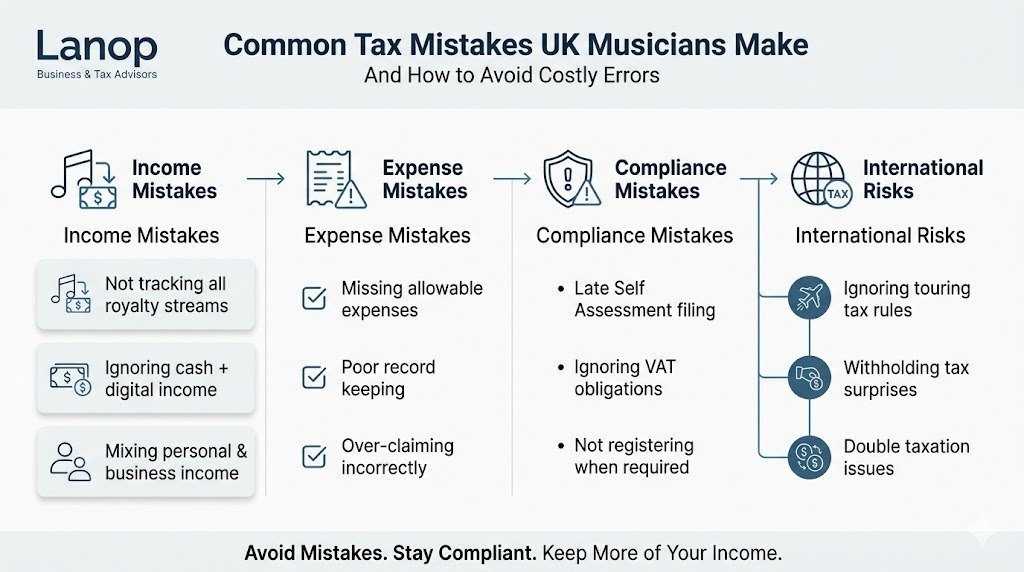
The 10 Most Common Tax Mistakes
Many artists treat their finances like a DIY demo functional, but lacking the polish needed for the big leagues. Here are the ten most common errors we see.
Not Registering as Self-Employed on Time
The Error: Thinking you only need to register once you are “famous” or making “real money.”
Scenario: Jamie has been doing weekend wedding gigs for eighteen months. He’s made £5,000 but hasn’t told HMRC because it’s just a “side hustle.”
Risk: Failure to notify HMRC by the deadline (October 5th in your second tax year) results in automatic penalties.
The Fix: Register for Self-Assessment as soon as you know your music income will exceed £1,000 in a tax year.
Not Declaring All Income (The Cash Trap)
The Error: Assuming cash payments at the end of a night don’t count as taxable income.
Scenario: A jazz trio gets paid £200 in an envelope after a set. They split it and spend it on the way home.
Risk: HMRC has become incredibly sophisticated at data-matching. If they audit you and see equipment purchases or travel that doesn’t match your declared income, they will dig deeper.
The Fix: Treat cash exactly like a bank transfer. Log it in your accounting software or spreadsheet immediately.
Poor Record Keeping
The Error: Relying on a “shoebox” full of crumpled receipts (or worse, no receipts at all).
Scenario: It’s January 30th, and Sarah is trying to find the receipt for the guitar she bought in May to lower her tax bill. She can’t find it and loses out on hundreds in tax relief.
Risk: You overpay tax because you can’t prove your expenses.
The Fix: Use digital tools. Apps like Dext or simple cloud accounting software allow you to snap a photo of a receipt and forget about it.
Claiming Incorrect Expenses
The Error: Claiming for things that aren’t “wholly and exclusively” for your music business.
Scenario: Claiming your entire home rent or your everyday “street” clothes as business expenses.
Risk: HMRC can reject these claims and issue fines for “careless” reporting.
The Fix: Follow the “wholly and exclusively” rule. If you use something for both personal and business (like a phone), you must apportion the cost.
Missing Legitimate Deductions
The Error: Not realizing the breadth of what you can claim.
Scenario: A producer doesn’t claim for their Spotify subscription, their home internet, or the “wear and tear” on their home studio.
Risk: A much higher tax bill than necessary.
The Fix: Research a full list of musician-specific expenses or consult accountants for musicians who know the industry inside out.
Not Understanding Multiple Income Streams
The Error: Lump-summing everything and failing to categorize royalties vs. performance fees.
Scenario: Mixing international royalties with UK teaching income, leading to confusion over VAT and foreign tax credits.
Risk: Misreporting can lead to double taxation on foreign income.
The Fix: Categorize your income as it comes in. This makes filing your return significantly faster.
Ignoring VAT Until It’s Too Late
The Error: Assuming VAT is only for “big corporations.”
Scenario: A successful session musician begins earning over £90,000 a year but forgets that this is the threshold for mandatory VAT registration.
Risk: You may have to pay a massive, backdated VAT bill out of your own pocket because you didn’t charge it to your clients.
The Fix: Monitor your rolling 12-month turnover. If you’re approaching £90,000, seek professional advice immediately.
Not Saving for Tax (The Cash Flow Shock)
The Error: Spending 100% of every gig fee as soon as it hits the bank.
Scenario: Mark earns £30,000 in a year. In January, he realizes he owes HMRC £5,000 but he has £200 in his account.
Risk: High-interest late payment penalties and debt.
The Fix: Open a separate “tax savings” account. Move 25–30% of every payment you receive into that account instantly.
Missing Deadlines
The Error: Thinking I’ll get to it eventually.
Scenario: Submitting a tax return on February 1st because “I was on tour.”
Risk: An immediate £100 fine, followed by daily penalties.
The Fix: Mark January 31st (Online filing) and July 31st (Payment on account) in your calendar with loud, recurring reminders.
Trying to Do Everything Alone
The Error: Assuming tax is simple enough to “DIY” while managing a creative career.
Scenario: Spending 40 hours a year struggling with tax forms, only to make a mistake that costs more than an accountant’s fee.
Risk: Stress, errors, and missed opportunities for tax optimization.
The Fix: Know when to delegate. Hiring accountants for musicians allows you to focus on the music while they handle the math.
What Musicians Can (and Can’t) Claim?
Understanding expenses is the fastest way to reduce your tax bill legally.
Claimable (Business Expenses)
- Instruments & Equipment: Purchases, repairs, strings, reeds, and insurance.
- Travel: Train tickets to gigs, or mileage (45p per mile) if using your own car for work.
- Professional Services: Fees for managers, agents, and accountants for musicians.
- Studio Costs: Rent, rehearsal space fees, and recording costs.
- Marketing: Website hosting, headshots, and social media promotion.
- Home Office: A proportion of your utilities if you practice or record at home.
Not Claimable (Personal Expenses)
- Everyday Clothing: If you can wear it on the street, it’s usually not a stage costume.
- Everyday Meals: You can’t claim your lunch just because you worked that day (unless you are away on an overnight tour).
- Commuting: Travel to a “regular” place of work (like a school where you teach every day) is often excluded.
Allowed vs. Not Allowed Examples
| Item | Status | Reason |
| Concert Black Suit | Allowed | Specifically for performance only. |
| New Jeans for a Gig | Not Allowed | Can be worn in daily life. |
| Guitar Strings | Allowed | Consumable business tool. |
| Gym Membership | Not Allowed | Personal health, not “wholly” for music. |
| Rehearsal Tea/Coffee | Not Allowed | General sustenance. |
Hidden Tax Traps Musicians Often Miss
If you want to beat the average taxpayer, you need to be aware of the “Advanced Level” traps.
Payments on Account
This is the single biggest shock for newly successful musicians. If your tax bill is over £1,000, HMRC assumes you’ll earn the same next year. They ask for half of next year’s tax in advance in January, and the other half in July. This can effectively double your first major tax bill.
Mixing PAYE and Music Income
If you teach music at a school (PAYE) but gig on the weekends (Self-Employed), your tax codes can get messy. Your “Personal Allowance” is usually used up by your salary, meaning every penny from your gigs is taxable.
International Gigs & Royalties
If you play in the EU or the US, or receive royalties from abroad, you may be subject to “Withholding Tax.” Without the right forms (like a W-8BEN for the US), you might pay tax twice on the same money.
Step-by-Step: Staying Tax Compliant
Follow this checklist to stay on HMRC’s good side:
- Register: Tell HMRC you are self-employed as soon as you hit £1,000 in turnover.
- Separate: Open a dedicated business bank account. Do not mix gig money with rent money.
- Log: Record every payment, including cash and royalties.
- Save: Squirrel away 25% of your income into a tax pot.
- Snap: Use an app to photograph every receipt for equipment, travel, or strings.
- File: Don’t wait until January. File your return in May or June to know exactly what you owe months in advance.
DIY vs. Hiring an Accountant
| Feature | DIY | Accountants for Musicians |
| Time | 20–40 hours of admin per year. | Minimal input required. |
| Accuracy | High risk of manual errors. | Guaranteed accuracy and compliance. |
| Tax Savings | Might miss complex deductions. | Optimizes your return to save money. |
| Audit Protection | You represent yourself. | They handle HMRC queries for you. |
| Stress | High (especially in January). | Peace of mind. |
Hiring a professional is usually a “net-zero” cost; the tax they save you often covers their fee, while buying you back dozens of hours to spend in the studio.
Why Choose Lanop Business and Tax Advisors?
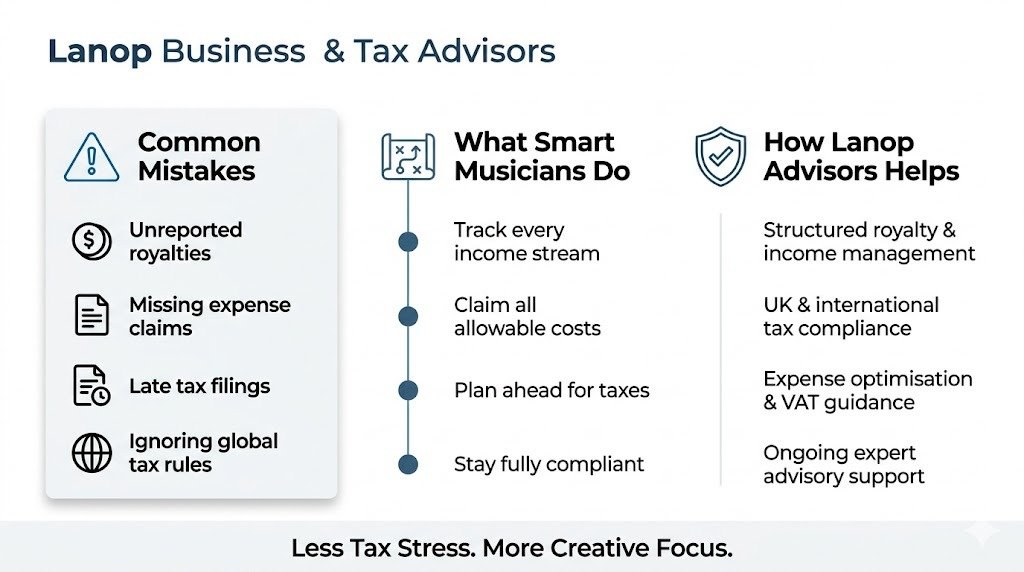
At Lanop, we speak your language. We understand that a musician’s income is volatile, seasonal, and complex. We aren’t just general accountants; we are specialized accountants for musicians who understand the nuances of PRS statements, tour accounting, and international withholding tax.
We help you reduce your tax liability legally, ensure you never miss a deadline, and take the administrative “noise” out of your life so you can focus on the music.
Frequently Asked Questions
What’s the biggest tax mistake UK musicians make with their income?
Not declaring all income sources streaming royalties, live performance fees, merchandise sales, session work, teaching income, and YouTube ad revenue all must be reported to HMRC. Many musicians assume small payments don’t count or that platforms report for them, but you’re responsible for declaring everything. HMRC cross-references data from platforms like Spotify, YouTube, and PayPal, so undeclared income triggers investigations, penalties, and backdated tax bills plus interest.
Can I claim my home studio and equipment as tax-deductible expenses?
Yes. You can claim instruments, recording equipment, microphones, software (DAWs, plugins), computers, studio furniture, and soundproofing materials. For home studio costs, use HMRC’s simplified flat-rate (£10–£26/month) or calculate actual costs proportionate to business use including rent, utilities, and internet. Keep receipts for everything and only claim the business portion mixing personal and business use requires accurate splitting to avoid HMRC challenges.
Do I need to register as self-employed even if music isn’t my full-time job?
Yes. If you earn any income from music gigs, royalties, teaching, session work you must register as self-employed with HMRC by October 5th following the tax year you started. This applies even if you have a day job and music is a side income. Failure to register triggers penalties from £100 upward, and you’ll still owe all tax and National Insurance on your music earnings.
How should I handle tax when collaborating with other musicians or sharing royalties?
Each collaborator reports their share of income on their own Self-Assessment return based on agreed splits. If you receive full payment then distribute to collaborators, you’re only taxed on your portion, but keep clear records proving the split arrangement. For formal collaborations, consider partnership agreements clarifying income shares, expenses, and tax responsibilities. Never assume HMRC knows about informal splits and document everything.
What music-related expenses do most musicians forget to claim?
Travel to gigs, rehearsals, and recording sessions (45p per mile or actual costs), accommodation for tours, marketing and promotional costs (social media ads, PR, website), professional photography and videography, music lessons for skill development, strings and maintenance, public liability insurance, and subscription services (distribution platforms, sample libraries). Musicians also miss claiming a portion of phone and internet bills used for business communications and promotion.
Conclusion: Don’t Let Tax Ruin the Rhythm
Tax mistakes can be costly but they’re completely avoidable. By staying proactive, keeping clear digital records, and understanding what you can claim, you can turn tax from a stressful burden into a manageable part of your music career.
Remember, tax planning isn’t just about staying compliant.it’s about keeping more of your income to invest back into your craft.
With the right guidance from Lanop Business and Tax Advisors, you can manage your finances with confidence and focus on what matters most to your music.