





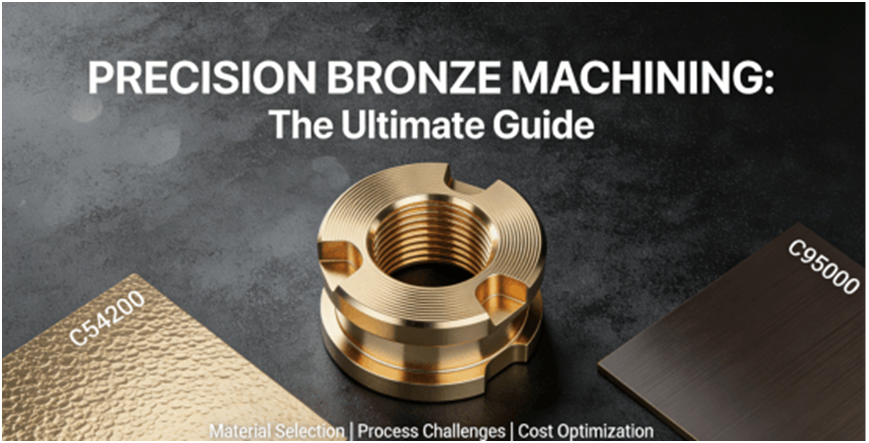
In aerospace and marine engineering, the best choice of precision components made from a bronze alloy is often a critical issue, balancing the need for performance with the potential for increased machining cost and complexity, or balancing the need for cost with the potential for reliability issues. This is often the result of a lack of clear understanding of the properties of the alloys and their machinability. This article will provide a clear framework for the selection of bronze alloys based on performance, machinability, and Total Cost of Ownership (TCO), analyzing the issue from five main aspects.
Phosphor Bronze vs. Aluminum Bronze: Which is the True Champion for Your Custom Part?
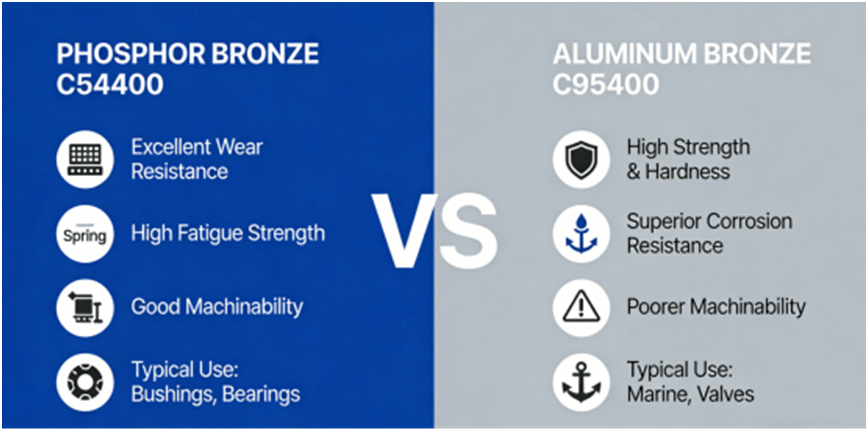
The variety of bronze alloys, though providing a broad spectrum of properties, poses a major problem for engineers in selecting the best material for their needs. Among the two major classes of bronze alloys, namely phosphor bronze and aluminum bronze, both possess certain advantages of their own.
Phosphor bronze, as represented by alloy C54400, is renowned for its outstanding wear resistance, fatigue strength, and machinability. These characteristics make it a prime candidate for applications involving bearings, bushings, and electric connectors, where reliability and smooth operation are of prime importance. Data on its composition and standard characteristics are available with authoritative bodies such as the ASM International materials database.
On the other hand, aluminum bronze (alloy C95400), which is one of the few representatives of the alloy class, does have several features such as high strength, excellent corrosion resistance, in particular to seawater, and good galling resistance, although its machinability is lower than that of the former. The primary uses of aluminum bronze are marine hardware, bearings, and valves, especially in highly corrosive environments.
However, the key takeaway is that no material is superior for all purposes, and the choice of material for custom bronze parts should be entirely based on the application for which they are made. Therefore, it is important to have knowledgeable CNC machining services available.
Conquering Built-Up Edge and Thermal Distortion: What Are the Core Process Challenges in Bronze CNC Machining?
Successfully machining bronze alloys requires navigating specific CNC machining services challenges. In the case of aluminum bronzes, the major issue is the tendency of the material to stick to the cutting tool, resulting in the formation of a built-up edge (BUE). This results in poor surface finish, dimensional inaccuracies, and excessive wear of the cutting tool. Moreover, the lower thermal conductivity of bronzes results in excessive heat buildup at the cutting region, causing undesirable thermal expansion of the workpiece material.
Strategic Solutions for Reliable Bronze Machining
Addressing these issues demands a strategic approach centered on process optimization.
l Optimizing Cutting Parameters and Tool Selection
The first step in defense is to adjust cutting speeds and feed rates to reduce heat generation and build up of BUE. Employing sharp tools with positive rake angles and coatings such as TiAlN can drastically reduce adhesion and friction. For a detailed study about parameter strategies, one can refer to a resource on CNC machining bronze which offers comprehensive guidelines.
l The Critical Role of Coolant Application
Using very high-pressure and high-volume coolant is necessary for the majority of bronze machining tasks. The proper use of coolant helps to cool the area, reduce the friction during cutting, and get rid of chips quickly. These actions are the main reasons for eliminating BUE and thermal distortions.
Advanced skills in manufacturing will be helpful not only in producing a large volume of parts but also in making the parts from bronze that are of high quality and do not have any defects and inconsistencies.
Why Do Aerospace and Marine Engineering Heavily Rely on Supplier Manufacturing Certifications?
This commitment to standardized excellence aligns with broader efforts, such as those by the National Institute of Standards and Technology (NIST), to advance measurement science and manufacturing standards. Therefore, when sourcing precision manufacturing services for critical applications, a supplier’s certifications are a fundamental component of risk mitigation and quality assurance for custom parts production.
From 5 Prototypes to 5000 Units: How to Choose a Cost-Effective CNC Strategy for Different Volumes?
The optimal CNC machining solutions strategy for bronze parts is highly dependent on production volume. A proficient manufacturing partner should offer seamless scalability from prototype to full-scale production.
Adapting CNC Strategies from Prototype to Production Scale
The optimal approach to custom bronze parts manufacturing shifts fundamentally with order volume, requiring different strategies in the tight-tolerance CNC machining services landscape.
l Agility in Prototyping and Low-Volume Runs
When making prototypes or small lots, having a 3-axis or 5-axis CNC machining is very important in terms of agility. With this kind of setup, you can easily go through various versions of a design and check if it works without having to spend a lot of money on special tools at first. Speed and changeability are the main things that this machine can offer, so it is very suitable for producing custom parts when the designs are still being finalized and tested.
l Efficiency Optimization for High-Volume Production
As production volume rises to hundreds or even thousands of units, attention mainly goes to cost, per-part efficiency. Producing a large quantity means carrying out process optimization, e.g., designing special fixtures and jigs to reduce cycle times, and strategic material sourcing. Basically, work towards the highest possible machine utilization and continual process refinement to exploit economies of scale and aid in scaling up production.
The Strategic Advantage of a Full-Scale Manufacturing Partner
Having a very capable and reliable supplier who can support the whole product lifecycle, starting from the very first concept to mass production of the product, is a result that far exceeds what would be expected. For example, this type of partner can use their experience with a prototype, making it possible to propose Design for Manufacturability (DFM) changes which will lead to a very significant lowering of the cost per unit when the product is fully produced. This type of capability that covers the entire chain without a break from fast turnaround prototypes to a high, volume CNC machining solution is actually one of the main traits of a mature and a strategic manufacturing partner.
Beyond Machining: How Surface Treatment Enhances Final Performance and Value of Bronze Parts
Once machining is done, surface finishing is necessary if the benefits of bronze machined parts are to be exploited in full. Appropriate finishing can significantly increase the product’s performance, durability, and appearance. For instance, chemical passivation that enhances corrosion resistance and keeps the surface color of the alloy unchanged, and electroplating (e.g. with nickel) that makes the surface harder and resistant to wear are typical processes.
Passivation is indispensable for parts that will be used in a marine environment. For decorative or architectural parts, methods such as glass bead blasting or polishing can be used to obtain specific textures or a mirror finish.
Choosing the appropriate surface treatment is an important final step in the precision manufacturing services process, as it not only ensures that the custom bronze parts comply with the technical requirements but also achieve maximum durability and the addition of value in their intended use.
Conclusion
Briefly, achieving the outcome of attractive custom parts by machining a bronze alloy is actually a systems engineering task. It requires first getting a thorough understanding of the material properties and machinability; it is made possible by, among others, advanced orderly production and quality system certification; it is continuously brought to perfection through suitable surface treatments. Another point of view selection of materials in combination with expert production is at the heart of both limiting the risks and providing cost-effective solutions over time.
Whether you are in the process of choosing bronze materials for a next, generation critical component, or looking for a trustworthy manufacturing partner, exploring the comprehensive engineering support and precision manufacturing services offered by JS Precision is a good idea. Do not hesitate to get in touch with us if you would like a professional analysis tailored to your specific design.
Author Bio
The author is a manufacturing process engineer with over 15 years of experience, specializing in the development of solutions for difficult-to-machine materials and high-precision components. His insights are consistently based on deep industry practice and ongoing process optimization research.
FAQs
Q: Is aluminum bronze always more corrosion-resistant than phosphor bronze?
A: Yes, typically so. Aluminum bronze, e.g., C95400, because of its aluminum and iron content, has a dense oxide coating that gives it exceptional resistance to corrosion and cavitation, making it the first choice for ship propellers, pumps, and valves.
Q: Is it necessary to eliminate cutting fluid when machining bronze parts?
A: This is strongly discouraged. Cutting fluid is vital when machining bronze parts. Cutting fluid is vital when machining bronze parts. Cutting fluid will cool the part and tool, remove chips, and prevent the workpiece from building up on the tool. Dry machining will reduce tool life and can even cause thermal distortion of the workpiece.
Q: What type of bronze is recommended for use in electrical connectors where conductivity is important?
A: When conductivity is important, bronze alloys with high copper content, such as tin bronzes, should be considered. However, it is important to find a compromise between conductivity and required strength. Specific recommendations should be made by referring to data sheets and talking to an application engineer at a precision manufacturing service provider.
Q: What are the major differences in the basis of costs between low-volume prototyping and high-volume production for bronze CNC machining?
A: Programming setup and part machining time greatly influence prototyping costs. In contrast, factors like raw material use, efficiency improvements through optimized cutting cycles, and the per-unit cost of dedicated fixtures and tooling that have been spread over many units heavily affect production costs at high volumes.
Q: What should I do to guarantee that the custom bronze parts I order will have very precise tolerances?
A: Pick a manufacturer with a very thorough quality control system. Ask them about the material of their measurement instruments used internally to control their processes. The final part is measured on a CMM, and a full-dimensional report is issued. Thoroughly via a CMM and price range of their CNC machining services. It is the simplest and best method to guarantee the receipt of qualified bronze machined parts.