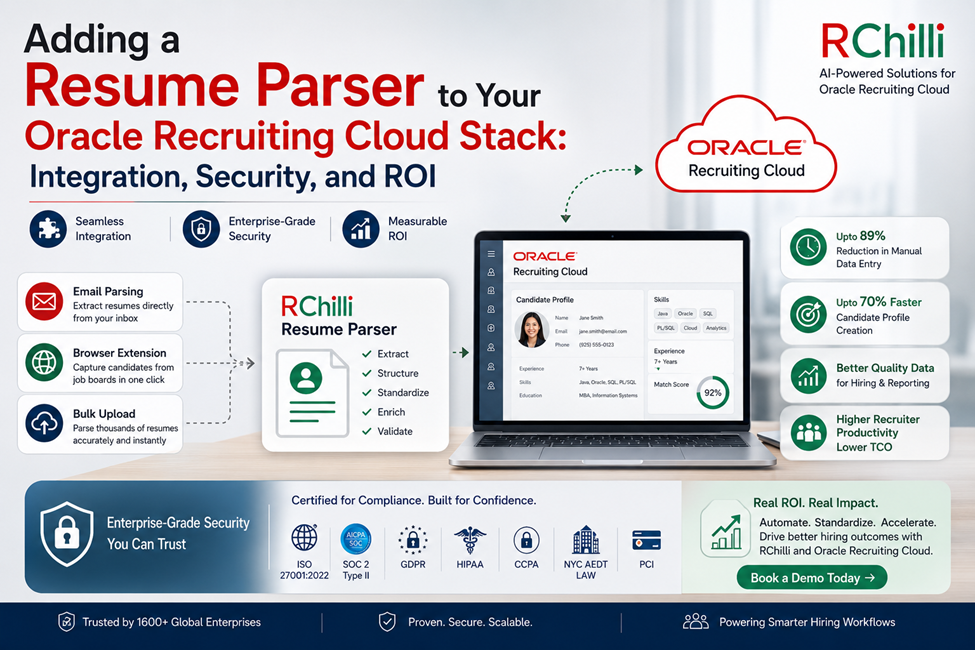
Adding a Resume Parser to Your Oracle Recruiting Cloud Stack: Integration, Security, and ROI

Key takeaways
- For Oracle implementation partners, a resume parser is a high-leverage add-on: it improves the client’s apply rate and data quality without changing their Oracle workflows.
- Evaluate any parser on three axes: integration speed (API-based, configurable in under an hour), security posture (recognized certifications, no resume storage), and measurable ROI (profile-creation time saved).
- The strongest candidate-data foundation also feeds downstream AI agents for matching, screening, and internal mobility.
- The decision comes down to whether the solution covers capture, hygiene, and sourcing as one Oracle-native system, and whether it can clear your client’s security review quickly.
If you implement or manage Oracle Recruiting Cloud — as a systems integrator, an implementation partner, or an in-house Oracle HCM owner — you have reached the stage where the question is no longer “should we automate resume handling,” but “which solution do we put into the stack, and how do we justify it.” This article is the decision-stage checklist: what to evaluate, how to prove ROI, and how to clear the security review without slowing the deal.
Why does a parser belong in an Oracle Recruiting Cloud deployment?
Because it fixes two problems your clients feel immediately — application drop-off and dirty candidate data — without disrupting the Oracle workflows you just configured. The evidence on drop-off is direct: SHRM reports 60% of candidates abandon long or complex applications, and Appcast shows completion falls from 12.47% on sub-five-minute applications to 3.61% on those over fifteen minutes. A parser that prefills the Oracle application from an uploaded resume attacks that gap at the source.
The second problem is data quality, which Gartner estimates costs organizations an average of $12.9 million per year. Inside Oracle, poor data quality looks like duplicate candidates, inconsistent job titles, and skills that cannot be searched reliably. A parser with data-hygiene tooling keeps records structured and standardized as they enter the system and reprocesses the ones already there. For an implementation partner, bundling this in means you deliver measurably better outcomes from day one rather than handing over a clean-but-empty Oracle environment.
How fast can it integrate with Oracle Recruiting Cloud?
Integration speed is the first thing to test, because it determines whether the parser fits inside a standard implementation template or becomes a custom project. The benchmark to hold vendors to is API-based connectivity configurable in under an hour once technical prerequisites are in place, with no re-architecture of existing Oracle workflows.
This is where an Oracle-native solution matters. RChilli for Oracle HCM is designed to plug into Oracle Recruiting Cloud through APIs and populate Oracle’s own fields, so recruiters keep working inside Oracle exactly as before. For a partner building a repeatable deployment, that means you can add it to your standard configuration, test it with sample resumes, and hand it to the client’s team without inventing a bespoke integration each time. The practical test during evaluation: ask to connect it to a sandbox tenant and parse a batch of real resumes the same day. If that is not possible quickly, integration risk is higher than the vendor claims.
What should the security review cover?
Anything that touches candidate PII has to clear your client’s privacy and security review, so treat this as a gating criterion, not an afterthought. The two questions that matter most are what the vendor is certified for, and whether it stores resume data.
A mature solution should hold recognized credentials — ISO 27001:2022, SOC 2 Type II, GDPR, HIPAA, CCPA, and PCI DSS among them — and offer FedRAMP-ready posture where public-sector clients are involved. Equally important is the data-handling model: a parser that does not store resume information during or after parsing materially simplifies a GDPR review, because there is no candidate-data retention to assess on the vendor side. Confirm hosting options too (for example GCP, AWS, Oracle Cloud, or Azure), since clients often have a required cloud. Walking into the security review with certifications, a data-processing agreement, and a no-storage architecture already documented is what keeps the evaluation from stalling.
Before you shortlist, request the vendor’s security pack — certifications, DPA, hosting options, and data-retention policy. A solution that hands these over immediately will clear your client’s review far faster than one that has to assemble them.
How do you prove ROI to the client?
Tie ROI to a metric the client already tracks: recruiter time spent creating and maintaining candidate profiles. The most quotable proof point is profile-creation time. Oracle Recruiting Cloud customers deploying automated parsing and data hygiene commonly report a 60% to 70% reduction in the time spent creating candidate profiles, alongside higher career-site completion rates and stronger shortlists from standardized, searchable skills data.
To build the business case, measure three things before and after a pilot:
- Profile-creation time: minutes of recruiter effort per candidate, manual baseline versus parsed. This is usually the headline saving.
- Application completion rate: the share of started applications that get submitted on the Oracle career site, which should rise as re-entry friction disappears.
- Data quality: duplicate rate and the proportion of records with standardized titles and skills, which drives search, reporting, and any downstream AI initiative.
Expressing the saving in recruiter hours reclaimed, then translating that into fully-loaded cost and faster time-to-fill, gives procurement a number it can approve. The combination of recruiter productivity and improved candidate capture is what makes the case stand up beyond a single budget cycle.
What does it unlock downstream?
Clean, structured candidate data is the prerequisite for everything Oracle clients increasingly want next, which strengthens the BOFU case. Once resumes are parsed into consistent fields and the database is standardized, that data becomes the input for AI-driven capability: skill-based matching and role recommendations, automated screening, job-description optimization, interview-question generation, and internal-mobility or succession insights.
For an implementation partner, this is a roadmap, not just a feature. Land the parsing and data-hygiene layer first, prove the time savings, then expand the client into AI agents that sit on top of the same structured data already in Oracle. You are not selling a point tool; you are establishing the data foundation that the client’s future HR-AI projects depend on.
How do the connectors fit a full rollout?
A complete intake strategy matters during implementation because candidate data arrives from several channels at once. The strongest deployments combine three connectors: a Browser Assistant for real-time sourcing from job boards and platforms like LinkedIn, an Email Importer that parses resumes forwarded to recruiter and careers inboxes, and Bulk Data Import for legacy migration and recurring high-volume uploads. Together they make sure no candidate touchpoint bypasses Oracle, which is exactly the gap that derails new implementations when teams discover resumes living in spreadsheets and inboxes outside the system. For a partner doing a legacy-ATS migration, bulk import also handles the historical data load with consistent mapping, so the client starts on Oracle with a populated, clean database rather than an empty one.
The decision checklist
Use this to make the final call:
- Integration: Is it API-based and configurable in under an hour, with no disruption to Oracle workflows? Can you connect a sandbox and parse real resumes the same day?
- Coverage: Does it handle PDF, DOCX, HTML, and the languages your client hires in, and does it standardize skills and titles against a real taxonomy?
- Hygiene: Can it reprocess existing Oracle records, not just new applications?
- Security: Does it hold the certifications your client requires, avoid storing resume data, and offer the hosting they need?
- ROI: Can you measure profile-creation time saved, completion-rate lift, and data-quality improvement in a short pilot?
- Future: Does the structured data it produces feed downstream AI matching, screening, and mobility?
A solution that answers yes across this list belongs in the stack. When you are ready to scope it against a live Oracle Recruiting Cloud environment, the fastest path is a short pilot with a real resume sample and a measured baseline.
Ready to evaluate it against your Oracle environment? Talk to an expert and run a scoped pilot that measures profile-creation time, completion rate, and data quality before you commit.
Frequently asked questions
Will adding a parser disrupt the Oracle Recruiting Cloud workflows we configured? No. An Oracle-native parser connects via API and writes to Oracle’s own fields, so recruiters keep their existing workflows. The parsing, data mapping, and standardization happen behind the scenes.
What security certifications should we require for a resume parser? At minimum ISO 27001:2022 and SOC 2 Type II, plus GDPR, HIPAA, CCPA, and PCI DSS coverage depending on your client, and FedRAMP-ready posture for public-sector work. Also confirm the vendor does not retain resume data after parsing.
How quickly can we show ROI to the client? A short pilot is enough. Measure recruiter profile-creation time before and after; reported reductions of 60% to 70% are common once parsing and data hygiene are live, and that single metric usually carries the business case.
Does the parser handle data already sitting in Oracle? Look for full-database reprocessing, which re-runs existing candidate records through current parsing logic and a standard taxonomy. This refreshes and standardizes historical data, not just new applications.
Can the same data power AI agents later? Yes. The structured, standardized candidate data the parser produces is the foundation for downstream AI matching, screening, JD optimization, and internal-mobility use cases inside Oracle.
About the author: This article was contributed by the RChilli team, which provides AI-powered resume parsing, data-hygiene, unbiased-hiring, and connector solutions embedded inside Oracle Recruiting Cloud and other enterprise HCM systems. Performance figures reflect outcomes reported by Oracle HCM customers; third-party statistics are attributed to their original publishers (SHRM, Appcast, Gartner).