





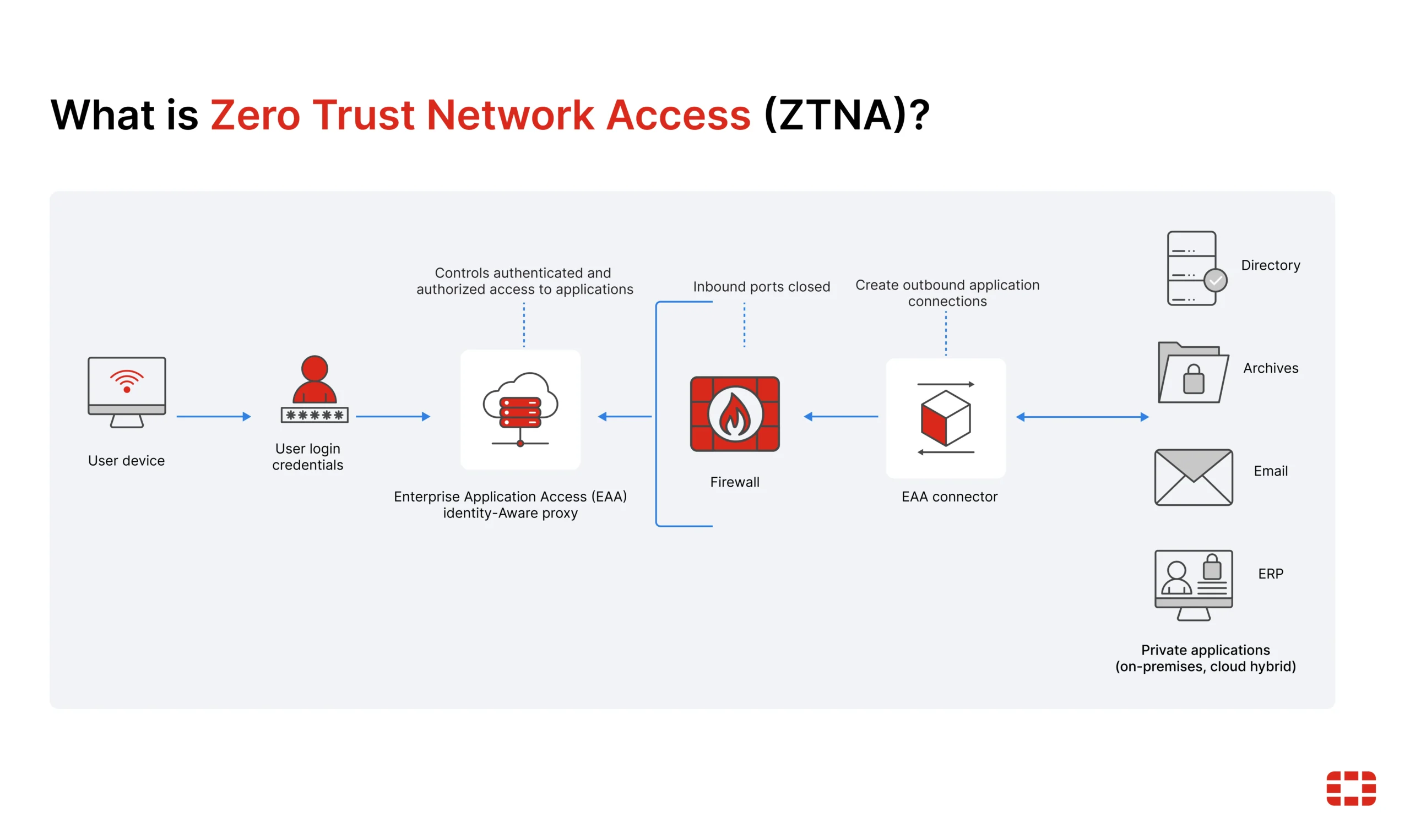
Remote access has become one of the most important and most contested dimensions of enterprise security. As organizations expand to support distributed workforces, contractor populations, and cloud-hosted applications, the question of how to grant remote users access to internal resources without exposing the broader network to risk has become central to security strategy. Zero trust network access, commonly abbreviated as ZTNA, has emerged as the most widely adopted answer to that question, replacing the implicit trust assumptions of legacy remote access tools with a model built on continuous verification and least-privilege enforcement.
Understanding what is ZTNA for secure remote access and how it differs from previous approaches is essential for any organization evaluating its remote access architecture.
The Problem with Legacy Remote Access
For most of the history of enterprise IT, virtual private networks served as the primary mechanism for remote access. A VPN creates an encrypted tunnel between a remote device and the corporate network, extending network access to users working outside the office. This model made practical sense when enterprise applications were hosted on-premises and most employees worked from predictable, company-managed locations.
The assumptions that made VPNs workable have largely dissolved. Enterprise applications now live in public cloud environments, SaaS platforms, and distributed data centers rather than in a single corporate network. Employees, contractors, and partners access those applications from devices and locations that fall far outside traditional IT governance. And adversaries have learned to exploit the broad network access that VPNs provide: once a user’s VPN credentials are compromised, the attacker typically gains the same expansive network access as the legitimate user, with few controls limiting lateral movement.
VPNs also impose operational overhead that grows as remote access scales. Capacity planning, appliance maintenance, and the management of split tunneling rules create an administrative burden, and the performance characteristics of backhauling remote traffic through a centralized VPN concentrator are increasingly incompatible with the low-latency requirements of cloud-delivered applications.
What ZTNA Is and How It Works
Zero trust network access is a security model and technology category that controls access to applications and resources based on the continuous verification of user identity, device health, and contextual signals rather than on network location. Where a VPN grants access to a network segment, ZTNA grants access to a specific application or resource, and only after the requesting user and device have been verified against a defined policy.
The core principles of ZTNA reflect the broader zero trust philosophy: no user, device, or connection is trusted by default, regardless of whether the request originates inside or outside the network perimeter. Every access request is evaluated against policy before a connection is established, and that evaluation incorporates real-time signals including user authentication status, device compliance, geographic context, and behavioral patterns.
ZTNA operates through a policy enforcement point a component that sits between users and applications, evaluates access requests, and either grants or denies a direct, application-level connection. Users never gain access to the underlying network; they interact only with the specific applications their policy permits. This application-level segmentation is the mechanism through which ZTNA prevents the lateral movement that makes compromised VPN credentials so dangerous.
The Relationship Between ZTNA and Zero Trust Architecture
ZTNA is one implementation of the broader zero trust architecture framework. Understanding how zero trust principles apply to remote access specifically requires familiarity with the architecture model that governs how access decisions are made across all enterprise resources. The zero trust architecture publication from NIST formally documented as Special Publication 800-207 provides the foundational framework that defines how zero trust applies across users, devices, applications, and data regardless of where they reside.
ZTNA implements the core tenets of that framework in the specific context of remote access: eliminating implicit network trust, enforcing least-privilege access to individual applications, and continuously verifying the identity and health of devices before and during sessions. Organizations implementing ZTNA as part of a broader zero trust strategy use the NIST framework to ensure that their remote access controls are consistent with their wider security architecture rather than a standalone point solution.
Key Capabilities of a ZTNA Solution
Effective ZTNA solutions share several defining capabilities that distinguish them from VPNs and other legacy remote access tools.
Identity-based access control is the foundation of any ZTNA implementation. Rather than granting access based on a verified network connection, ZTNA evaluates the authenticated identity of the requesting user typically through integration with an enterprise identity provider and matches that identity against access policies that define which applications the user is permitted to reach.
Device posture assessment adds a second layer of verification. Before granting an application-level connection, ZTNA checks whether the requesting device meets defined compliance criteria: whether the operating system is current, whether endpoint security software is active, and whether the device belongs to the set of managed or trusted devices recognized by the organization. Devices that fail posture checks can be denied access or directed to a remediation workflow before being granted limited access.
Least-privilege application access is the structural principle that distinguishes ZTNA from network-centric access models. Each user receives access to precisely the applications their role requires and no access to the broader network infrastructure in which those applications reside. This means that a compromised user account grants an attacker access only to the applications that user was permitted to reach, not to the entire internal network.
Continuous session monitoring allows ZTNA platforms to revoke or restrict access during an active session if conditions change. A session that begins from a compliant device in an expected location can be terminated automatically if the device falls out of compliance or if behavioral signals suggest account compromise. This dynamic enforcement capability is not available in traditional VPN architectures, which grant access at connection time and maintain that access until the session is explicitly terminated.
How ZTNA Addresses the Remote Workforce Security Challenge
The shift to distributed work has made secure remote access a persistent operational requirement rather than an occasional exception. Governments and standards bodies have responded with formal guidance recognizing the security risks that accompany large-scale remote work and the controls organizations need to manage them. The federal telework security guidance published by CISA addresses these risks across device management, network security, and access control, providing a framework against which organizations can evaluate the adequacy of their remote access controls.
ZTNA addresses the core risks that the remote work environment introduces. Users who access applications from personal devices in uncontrolled network environments are a persistent source of credential compromise and session hijacking risk. ZTNA’s posture assessment capabilities ensure that only devices meeting defined security standards can establish application-level connections, reducing the exposure created by unmanaged or poorly maintained endpoints.
Agent-Based and Agentless ZTNA
ZTNA implementations generally fall into two architectural models. Agent-based ZTNA requires a lightweight software agent on the user’s device that communicates device posture and identity context to the ZTNA policy enforcement point. This model enables the most granular posture assessment and supports continuous monitoring of device health throughout the session.
Agentless ZTNA provides access through a browser without requiring software installation on the user’s device. This model is better suited to contractor access, third-party users, or environments where endpoint agent deployment is impractical. Agentless implementations typically offer less granular device posture visibility than agent-based models but provide a practical path to ZTNA adoption in complex or heterogeneous access scenarios.
Many enterprise ZTNA deployments combine both models, applying agent-based access for managed employee devices where full posture assessment is possible, and agentless access for third-party or unmanaged devices where application-level isolation is the primary control.
Why ZTNA Is Replacing VPN in Enterprise Environments
The migration from VPN to ZTNA in enterprise remote access is driven by three converging factors. First, the application landscape has shifted irreversibly to cloud and SaaS, making network-centric access models structurally mismatched to where applications actually live. ZTNA’s application-level connectivity model aligns naturally with cloud-hosted resources, removing the need to route user traffic through centralized network infrastructure that adds latency without adding security.
Second, the threat model for remote access has evolved. Credential-based attacks against VPN infrastructure have become a consistent and highly effective attack vector, documented in threat intelligence reporting from government and private sector sources alike. ZTNA reduces the blast radius of a compromised credential by limiting the attacker’s access to individual applications rather than to the full network.
Third, operational efficiency increasingly favors ZTNA. As remote access scales to cover entire workforces, the per-user management overhead of VPN architectures becomes a significant burden. ZTNA platforms that integrate with identity providers and endpoint management tools automate access provisioning and revocation, reducing the administrative effort required to maintain secure remote access at scale.
Frequently Asked Questions
How does ZTNA differ from a VPN in practical terms?
A VPN grants access to a network segment after verifying a user’s credentials at connection time, while ZTNA grants access only to specific applications after continuously verifying user identity, device health, and context. The practical difference is that ZTNA limits the blast radius of a compromised credential to individual applications rather than to the entire network, and it enforces access controls based on real-time posture rather than a one-time connection verification.
Is ZTNA suitable for third-party and contractor access?
ZTNA is particularly well-suited to third-party access scenarios because it grants precise, application-level access without exposing internal network infrastructure to the accessing party. Agentless ZTNA implementations enable secure access from unmanaged devices without requiring software installation, making contractor and partner access simpler to provision and more consistently controlled than VPN-based alternatives.
Does implementing ZTNA require replacing existing security infrastructure?
ZTNA implementations typically integrate with existing identity providers, endpoint management systems, and security monitoring platforms rather than requiring wholesale replacement of existing infrastructure. Organizations commonly deploy ZTNA alongside existing VPN infrastructure during a transition period, progressively migrating application-by-application as ZTNA policies are defined and validated.