




More Than a Collar: Why Clerical Dress Still Matters
Clerical shirts have been doing quiet, dependable work for centuries, and they are still at it. There is something about a priest walking into a room in his collar that settles the atmosphere almost immediately. It is not authority exactly, more a kind of calm recognition. People know who he is, what he represents, and, more often than not, they are glad he is there.
That is no small thing in an age when so much of public life feels anonymous and untethered. Clerical dress cuts through all that without a word being spoken. This is not an article about church dress codes or liturgical correctness. It is about the everyday garment beneath the vestments, the clerical shirt that a priest pulls on in the morning and wears through whatever the day throws at him.
A Brief History of the Clerical Shirt
The idea of clergy dressing differently from everyone else goes back to the earliest centuries of the Church. By the medieval period, distinct ecclesiastical dress was already well established, with Church authorities issuing guidelines about what clergy should wear in public to mark their status and commitment.
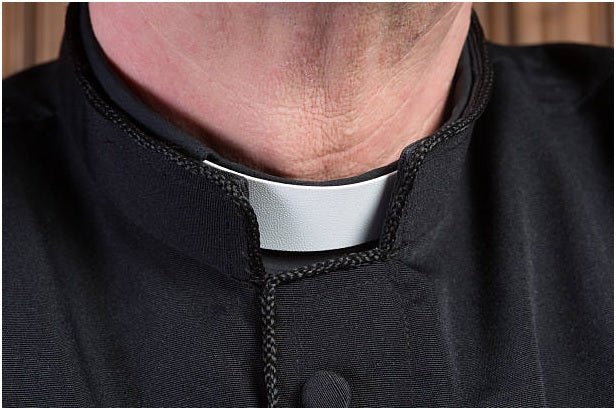
The Roman collar as we know it today, that distinctive white band or insert at the throat, took its modern form in the 19th century. It became standard across Roman Catholic clergy and was adopted with variations by Anglican and some Protestant traditions too. Orthodox clergy tend toward different conventions, often favouring cassocks for daily wear, but the underlying principle is the same: visible distinction signals a distinct vocation.
What is remarkable is how resilient the collar has proved. Fashions have come and gone, anticlerical movements have tried to push clergy into civilian dress, and yet the collar has endured. It is a design that turns out to be almost perfectly suited to its purpose.
What Actually Goes Into a Clerical Shirt
The Anatomy of the Collar
Not all clerical shirts are built the same, and the collar is where the meaningful differences live. The three main styles are the tab collar, the neckband collar (sometimes called the tunic collar), and the full collar shirt.
The tab collar shirt looks broadly like a conventional dress shirt but has a small white tab that inserts into a gap at the front of the collar, creating the characteristic white band. The neckband style features a full band around the neck with a white insert at the front, giving a cleaner, more structured look. The full collar shirt is cut with the clerical collar built directly into the garment, all in one piece, typically in white.
Detachable inserts are popular because they are easier to keep pristine, and a clean white collar against black fabric does a great deal of pastoral heavy lifting.
Fabric, Fit and Colour
Black is the default, and for good reason. It is authoritative without being showy, practical in terms of laundering, and immediately legible as clerical dress. Grey is a softer alternative favoured by some, while white clerical shirts are common in warmer climates or for summer wear. Some traditions incorporate liturgical colours, though this tends to be reserved for more formal contexts.
Fabric matters more than people might expect. A priest is not sitting behind a desk all day. He is moving between a hospital ward, a school hall, a draughty church and a parishioner’s front room. Cotton is comfortable and breathable for cooler conditions. Polycotton blends handle repeated washing well and stay smart with minimal effort. For warmer weather, lighter poplin weaves or moisture-wicking fabrics are increasingly available.
The shift toward better fit is real. Younger clergy in particular are choosing shirts cut closer to the body, which look smarter and feel less like wearing a uniform. The clerical shirt has, quietly, become something worth dressing well in.
The Working Wardrobe of a Priest
Consider what a fairly ordinary week looks like for a parish priest: morning Mass, visits to the local hospital, a school assembly, a funeral, a couple of home visits, an evening parish meeting and, somewhere in there, preparation for Sunday. That is a significant range of social contexts, emotional registers and physical environments.
The clerical shirt holds up across all of them without requiring a change of outfit. It is smart enough for a funeral, approachable enough for a chat with a nervous teenager after school, and sufficiently understated to avoid drawing attention away from the people a priest is there to serve.
Durability and easy care are not afterthoughts. A priest who is washing his own shirts and ironing on a Saturday evening needs fabrics that behave.
Dressed to Serve: The Theology Behind the Clothes
There is a theological dimension to clerical dress that goes beyond aesthetics. Wearing a distinctive collar is a form of public commitment, a visible sign that this person has made particular promises and is accountable to a community and a tradition.
Many priests speak of the collar as an invitation. Strangers will approach a man in a collar in a supermarket, on a train, in a hospital waiting room, who would never approach a man in an ordinary shirt. The collar opens conversations that might otherwise never happen. That visibility is, for most clergy, not a burden but a privilege.
The Church has never been naive about the power of symbolic dress. What we wear communicates something about who we are and what we are for.
How Clerical Fashion Has (Quietly) Evolved
There is more choice in clerical shirts now than there was a generation ago. Specialist Catholic suppliers have expanded their ranges considerably, responding to clergy who want something that fits well, lasts well and does not feel punishingly utilitarian.
Social media has played its part. A renewed interest in Catholic identity among younger Catholics, priests and laypeople alike, has brought clerical aesthetics into conversation in ways that feel fresh without being irreverent. Good design and faithful witness turn out to be entirely compatible.
Getting It Right: What to Look for When Buying
If you are navigating the world of clerical shirts for the first time, or looking to upgrade what is already in the wardrobe, a few things are worth thinking through:
- Collar style: Tab, neckband or full collar, each suits different preferences and contexts
- Fabric: Cotton for comfort, polycotton blends for durability and easy care
- Fit: Look for a contemporary cut rather than the boxy styles of older stock
- Occasion range: A good clerical shirt should work across the full breadth of parish life
- Care: Check washing instructions before buying, especially if hand-washing is not an option
Buying from a specialist Catholic supplier is worth doing. They understand the specific requirements of clerical dress in a way that a general clothing retailer simply does not.
Still Recognised, Still Relevant
The clerical shirt has outlasted countless fashion cycles and cultural upheavals by being genuinely useful, genuinely meaningful and genuinely well designed for the life it is made to support. That is a combination that tends to endure.
Beyond formal occasions, many choose well-tailored shirts with a distinctive collar designed for comfort and everyday wear, combining practicality with a recognisable identity.
There is something admirable about a garment that carries that much weight with that little fuss. Clerical shirts have been doing exactly that for a very long time, and by the look of things, they show no signs of stopping.