




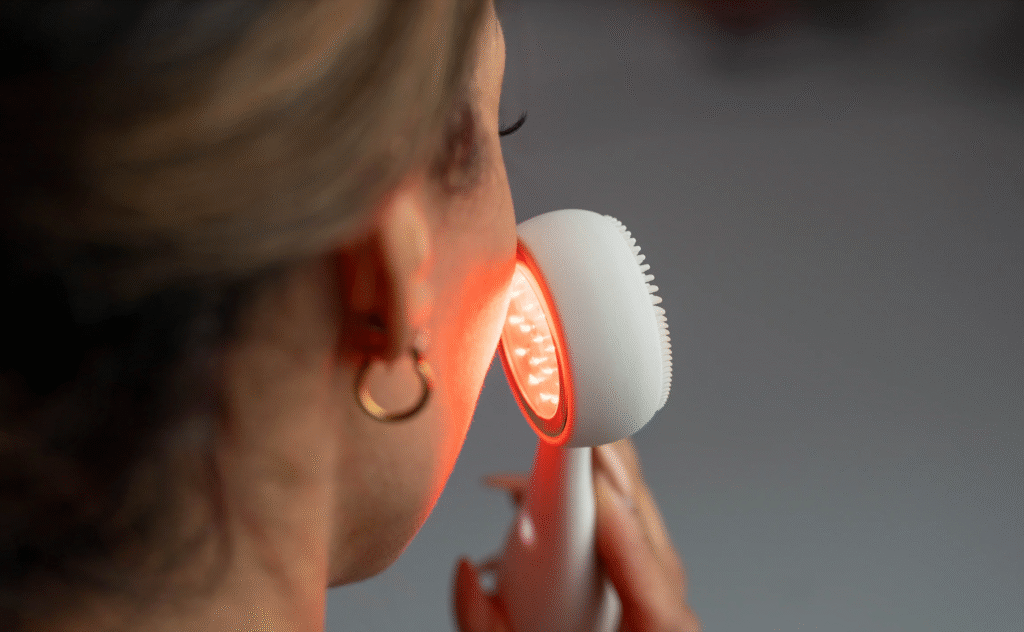
Remember the Clarisonic? That vibrating face brush everyone’s mom had? The company shut down in 2020. What replaced it looks nothing like a spinning brush. People are now strapping LED masks to their faces, running electrical currents along their jawlines before work, and letting phone apps diagnose their breakouts.
It sounds excessive. It probably is, a little. But the market hit $15 billion last year, so clearly something is sticking.
Light Therapy Got Small Enough to Use at Home
Phototherapy for skin conditions isn’t new. Dermatologists have used UVB light to treat psoriasis since the 1970s, and it works well. The problem was always access: big machines, small appointment windows, and a lot of driving back and forth.
Handheld devices changed that equation. Red light panels for anti-aging get the most buzz on social media, but the more significant shift is happening with medical-grade phototherapy. Patients with psoriasis and vitiligo have started posting uvb light therapy at home results in condition-specific forums, comparing notes on dosing schedules and tracking plaque clearance over weeks.
A trial published in the British Journal of Dermatology found home UVB sessions achieved clearance rates nearly matching those of hospitals (a difference of 5% or less). For someone spending three hours twice a week commuting to a clinic, that gap is easy to accept.
Not every home device ships with proper dosimetry guidance, though. And ramping up exposure too quickly causes burns. The technology works; the instructions sometimes don’t.
Microcurrent Finally Has Studies Behind It
NuFACE has sold microcurrent devices since 2005. ZIIP came along later with app-connected protocols. For most of that time, the evidence was thin: lots of testimonials, not many controlled trials.
That started changing around 2022. Researchers publishing in the Journal of Cosmetic Dermatology found that 60 days of daily microcurrent use produced measurable (their word, not mine) improvements in jawline contour. The electrical pulses supposedly boost ATP production at the cellular level, which over time firms things up.
Measurable and visible aren’t the same thing, of course. Most people describe the results as “my face looks slightly less tired.” About 40% quit using their device within six months. The technology probably works for the people who stick with it, but sticking with it turns out to be the hard part.
Radiofrequency at Home Is a Compromise Worth Making
A single Morpheus8 session costs $2,000 to $4,000. LYMA’s home RF device costs $2,000 once. TriPollar’s STOP VX runs about $400. The math is obvious, even if the results aren’t identical.
All RF devices do the same basic thing: heat your dermis to roughly 42 degrees Celsius so your body thinks there’s minor damage and starts producing fresh collagen. Professional machines hit that temperature in seconds. Home devices take longer, feel gentler, and need way more sessions before anything changes.
A McKinsey analysis of beauty industry trends estimated that AI and tech-driven tools could influence up to 70% of customer interactions by 2027, and RF devices are riding that wave. UK sales of consumer RF devices tripled between 2022 and 2024. So people are buying them, and enough people are satisfied to keep the category growing. Whether “satisfied” means “seeing real results” or “enjoying the ritual” probably varies by person.
Skin Analysis Apps Got Weirdly Sophisticated
Early skin-scanning apps were glorified filters. Point your camera, get a score, buy the serum they recommend. Pretty transparent upsell.
The newer ones do something genuinely different. Proven Skincare pulls in local humidity, pollen counts, and UV data. Haut.AI cross-references your skin photos against environmental variables you’d never think to check, like municipal water hardness. L’Oreal built a handheld scanner called Cell BioPrint that reads individual cell health, and Samsung has something similar in development.
The concept of computer-aided diagnosis has existed in medicine for decades, and these beauty apps are essentially applying the same principles to cosmetic analysis. The technology is impressive on paper. The weak link is still the phone camera. Bathroom lighting at 7 AM produces very different images than natural light at noon, and the algorithms don’t always account for that. A dermatologist working under controlled conditions catches things these apps can’t, particularly anything suspicious that needs a biopsy.
Nobody Agrees on How to Regulate Any of This
The FDA classifies most home skincare devices as cosmetic, which means companies don’t need much evidence before selling them. The EU’s Medical Device Regulation (MDR 2017/745) demands more from products making health claims.
So the exact same device might be marketed as a therapeutic tool in one country and a beauty gadget in another. That’s confusing for anyone shopping across borders, and it makes comparison shopping nearly impossible.
The practical advice: ignore the regulatory labels and look for published clinical studies. If a company funded a peer-reviewed trial, they’ll mention it. If the only evidence is influencer testimonials, adjust your expectations.
What Comes After All This
Biosensor patches are probably next. Thin, wearable films that track hydration, UV exposure, and water loss in real time. A few prototypes already exist; consumer versions are likely 2 to 3 years out.
The devices keep shrinking and the prices keep dropping. Professional dermatology isn’t going anywhere, but the space between appointments is getting a lot more interesting.