



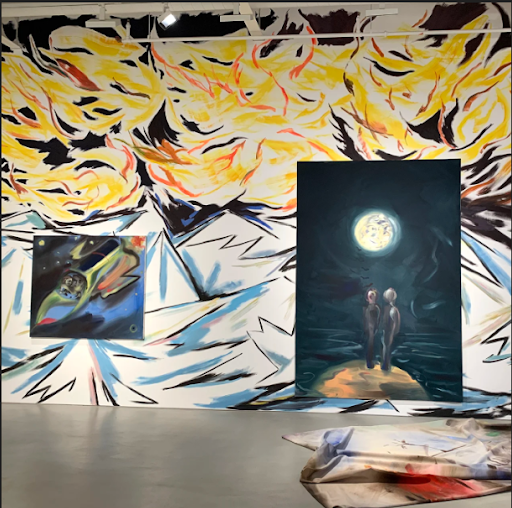
Few territories in the visual arts have proven as enduring — or as restless — as abstraction. Rather than anchoring itself to recognizable subjects, abstract work operates through feeling, structure, and suggestion, asking viewers to meet it halfway. Today, this impulse runs through nearly every discipline: painting, sculpture, ceramics, digital installation, and hybrid forms that resist easy categorization. The growing visibility of contemporary abstract art speaks to a wider hunger for work that doesn’t explain itself so much as open itself — work that prioritizes experience over illustration, and resonance over recognition. Moving along the continuum between the figurative and the purely formal, today’s artists are renegotiating what images can do and what they can mean.
A Living Inheritance: Abstraction’s Historical Roots
The groundwork for contemporary abstraction was laid in the early decades of the twentieth century, when artists began treating the canvas as a space for internal logic rather than external mimicry. Movements like Cubism, Futurism, and Abstract Expressionism dismantled the convention that a painting must resemble the world. Pioneers such as Wassily Kandinsky, Piet Mondrian, and Kazimir Malevich proposed instead that color, rhythm, and geometric structure could carry emotional and philosophical weight on their own terms. Contemporary practice builds on this legacy — but loosely. Today’s abstraction is less doctrinaire, more eclectic, drawing on psychology, cultural criticism, material experimentation, and personal history. The non-representational image is no longer a manifesto; it is a method.
Between Recognition and Pure Form
A significant number of contemporary artists don’t begin in abstraction — they arrive at it. Starting from the human body, a landscape, or an everyday object, they gradually strip away specificity until what remains is something more distilled: a gesture, a pressure, a mood. This process of reduction is generative rather than diminishing. When a recognizable figure dissolves into shape and line, viewers are no longer guided by narrative; instead, they are asked to attend to qualities — weight, rhythm, tension — that figurative work might have obscured. The passage from likeness to form creates a richer dialogue than either mode could sustain alone, giving the work multiple points of entry and layers of possible meaning.
Ceramics as Conceptual Territory
Among the most vital sites of abstract exploration today is contemporary ceramics — a field that has undergone a fundamental reimagining over recent decades. Once defined by its relationship to utility, ceramics has increasingly become a medium for sculptural and conceptual ambition. Artists working in clay now embrace asymmetry, organic irregularity, and experimental surface treatments to produce objects that hover between the functional and the purely evocative. Clay’s physical properties — its memory of touch, its sensitivity to fire, its capacity to record the marks of making — give abstract ceramic work a tactile dimension that paint on canvas cannot replicate. A vessel-like form may carry echoes of the body, the landscape, or the container, without committing to any single reading.
The Process as the Point
One of the defining shifts in contemporary abstraction is a turn toward process itself as subject matter. Artists are increasingly interested not just in the finished object but in the conditions of its making: the way pigment behaves when thinned past a certain point, the unpredictability of a kiln firing, the traces left by a tool dragged across a surface while still wet. This foregrounding of materiality and chance reframes what it means to make a work of art. Rather than executing a predetermined vision, the artist enters into a negotiation with their medium — accepting its resistance, following its suggestions, and treating accidents as information. In this light, both contemporary abstract painting and contemporary ceramics become records of an encounter rather than products of a plan.
Color and Form as Emotional Architecture
Abstract work operates most powerfully through the relationship between color, form, and negative space. These elements aren’t decoration; they are the work’s primary language. A shift in hue can alter the emotional register of an entire composition. The relationship between a solid mass and the void surrounding it generates tension or release. Scale transforms the viewer’s sense of their own body. Contemporary abstract artists exploit these dynamics with precision, building works that communicate states of feeling — grief, elation, restlessness, awe — without narrating them. This openness is the work’s strength: because nothing is stated explicitly, nothing is foreclosed. Each viewer brings their own associative landscape to the encounter.
Abstraction Without Borders
The reach of contemporary abstraction extends well beyond painting and ceramics. Installation artists construct environments that surround the viewer, collapsing the boundary between object and space. Digital practitioners generate forms and movements that no physical medium could produce. Mixed-media works splice together materials — glass, textiles, light, sound — in configurations that resist easy classification. What unites these varied approaches is a shared commitment to affect over illustration, to the experiential over the explanatory. Abstraction, in this sense, is less a style than a disposition — an orientation toward the possibilities of form that cuts across medium, scale, and context.
The Viewer as Co-Creator
Abstract work changes what it asks of its audience. Where figurative art often supplies a subject and invites attention, abstract art supplies a situation and invites participation. The viewer cannot simply decode the image; they must inhabit it, bringing their own memories, associations, and emotional states into the interpretive process. This is not a deficit of meaning but a surplus of it. Contemporary abstract art and contemporary ceramics both function as open structures — stable enough to hold attention, permeable enough to accommodate multiple readings. The meaning that emerges from an encounter with abstract work is always partly authored by the person standing in front of it.
Artists Mapping the Terrain
The breadth of contemporary abstraction can be traced through a handful of practitioners whose work charts its range. Gerhard Richter moves fluidly between photographic realism and gestural painting, treating abstraction not as an escape from the visible world but as another way of engaging its complexity. Anish Kapoor creates sculptural objects that confuse perception, drawing viewers into vertiginous encounters with surface, depth, and reflection. In ceramics, Edmund de Waal builds quiet, repetitive installations from porcelain forms that reward sustained attention with subtle accumulations of variation. None of these artists practice abstraction the same way; together, they suggest how broad and genuinely various this territory remains.
What Abstraction Preserves
The movement from figures to forms traces something essential about the evolution of contemporary art — a deepening conviction that the most significant things art can communicate may be precisely those that resist direct statement. Contemporary abstract art and contemporary ceramics both inhabit this belief, using shape, surface, and material to approach what language approaches differently: emotion, perception, the felt texture of experience. In a cultural environment dense with explicit imagery and declarative messages, abstraction offers a different kind of clarity — not the clarity of what is shown, but the clarity of what is sensed. The work doesn’t tell you what to feel. It creates the conditions in which feeling becomes possible.